Sticking within the kiddie records realm, I had mentioned that such records got repackaged and rereleased quite a bit.
A case in point is Peter Pan Records' recording of "Jingle Bells" as credited to the Caroleers:
Based on the label (depicting Pan the Greek God rather than Peter Pan the flying boy), I think this is the first release, paired with "Adeste Fidelis" on one side of a 78 rpm record:
I believe that would be from the early 1950s. I see "Jingle Bells" as being released in 1950, but the flipside of this particular record is "I Saw Mommy Kissing Santa Claus," which was a hit in 1952, so it couldn't be earlier than that.
This is the label of the record usually shown to be from 1950:
That looks newer, though, doesn't it?
Somebody probably knows the answer, but it would take a lot of research!
Whatever the case, there are a zillion label variations over the years. Here are some:
And here are some picture sleeves:
I think that's the same recording over and over, so Peter Pan got some good mileage!
We switch back to the world of kiddie records for this version of "Jingle Bells" recorded by the veteran slapstick team the Three Stooges for Golden Records in 1959:
That's an interesting little number, as is the flipside:
I think those two tracks were first released in 1959 as part of these multi-song EPs, then paired as a single in 1960 (see top image):
It can be really hard to keep Golden Records releases straight, however, as they were always repackaging and rereleasing their recordings over and over, as was the case with all the kiddie labels.
I notice that "Jingle Bells" was titled "Jingle Bells Drag" on the EPs with the "Drag" dropped for the single. I'm guessing the title was a takeoff on "Jingle Bell Rock," which had been first released just a couple of years before. Otherwise, I don't get the joke!
I think the two tracks from the single in question, "Wreck the Halls with Boughs of Holly/Jingle Bells," are the strongest Christmas tracks from the boys, relatively speaking, as they deconstruct traditional songs and create little audio dramas, whereas the other recordings are more like the Stooges croaking their way through novelty songs that had already been recorded in vastly superior versions.
As far as any musical talent goes, I think Larry does the heavy lifting vocally, but that's not surprising as Larry Fine had played the violin professionally.
The Three Stooges were at an interesting career point at the time if these recordings. Moe Howard and Larry Fine had been working together for 30-ish years and currently had Curly Joe DeRita in the third Stooge spot.
The act had a recent resurgence in popularity from their old shorts being shown on TV and finding a new audience of children. But the Stooges didn't make any money for residuals on the shorts, so they needed to find new projects, including kiddie records!
A couple of things I'll throw in from when I was a kid around the schoolyard: A lot of kids thought Curly and Curly Joe were the same guy and one of the Stooges was a "Stooger!"
Still thinking Western music, my thoughts rolled around to the Prairie Ramblers, who included an interesting take on "Jingle Bells" in their recording of "Cowboy Santa Claus" for the Standard Transcription Library in (I think) 1946:
You'll notice that the chorus of that song and the instrumental break are actually the melody of "Jingle Bells," which is pretty neat!
They also cut another Christmas song on the same disk, "Christmas Chimes," which sounds more like it would be a takeoff on "Jingle Bells," but is not:
Those are fun couple of tracks that I think were only recorded as transcriptions, meaning they were available for radio play by subscribers, but not for retail purchase as regular records by regular consumers.
This would be late in the history of the Prairie Ramblers, as the group broke up in 1947 after having formed in the early 1930s.
The group really caught on when they joined forces with singer/songwriter Patsy Montana, whose 1935 song "I Wanna Be a Cowboy's Sweetheart" took the country music world by storm. Here's the original recording:
Still sounds great!
Patsy went on to a successful solo career while the boys continued to enjoy success on their own.
Here's a 1941 recording:
Closer to the time of the transcription recording, here are both sides of a single for the new Mercury Records from 1945:
Dig that early Mercury label!
Those sides show the bands versatility as well as their keeping up with the times!
The group also backed smooth-voiced singing cowboy Rex Allen, including on this 1946 release:
So, a decade or so of solid work by the Prairie Ramblers!
We switch genres and decades to go back to 1934 for a version of "Jingle Bells" included by Men About Town on a two-sided Christmas disk on Decca Records:
That's fun!
Hot on the heels of "Christmas Party," the Men come back with "Christmas Day," the next sequential release on Decca:
A couple of fun records from when there weren't a ton of Christmas records to listen to!
I don't really know anything about Men About Town other than they had a few records on the Decca label.
And isn't there a female voice mixed in?
What I find most intriguing is that the "Christmas Day" sides were re-released in 1940 as part of a Christmas album (when albums were really albums!), as seen at the top of the page.
Is this the first multi-artist Christmas compilation album? It's so old that Bing Crosby only had one two-sided record they could use - "White Christmas" was still two years away - and Kenny Baker gets half the album!
The only other Decca record involving Men About Town that I can dig up is this one from 1938 on which they provide backing vocals for prolific studio singer Dick Robertson:
That's a snappy arrangement (the band includes Frank Signorelli on piano), but it doesn't seem Western-style at all and is somewhat at odds with the Lone Ranger theme.
I first knew that song from the Roy Rogers version, also from 1938 (I came across it years later, of course), which gives the song a ton of Western flavor:
Roy Rogers and the Lone Ranger had a lot of fans in common and I'm sure there were many schoolyard debates over who was the better horse: Silver or Trigger!
Naturally I have a couple of additional things of note regarding that song!
1938 was a banner year for the Lone Ranger, as in addition to his continued success on the radio and the song "Hi-Yo Silver," he made his live-action debut in the great Republic Pictures serial bearing his name!
Also, the song "Hi-Yo Silver" was co-written by Vaughn de Leath, the pioneering female radio vocalist who purportedly invented crooning so as not to shatter the early radio microphones with loud singing.
She was very popular in the 1920s (she was sort of Kate Smith before there was Kate Smith), but she had largely stopped performing and was focusing on songwriting by 1938.
Another of her songs to be recorded in 1938 was "The Man with the Whiskers" by the Hoosier Hot Shots!
Where did I start off with this post? Oh, yeah, Men About Town! How is it always such a short leap back to the Hoosier Hot Shots?
We hover around the early 1950s with this 1952 version of "Jingle Bells" as recorded by bandleader/vocalist Edmundo Ros and his Rumba Band on the British Decca label:
That's a very catchy arrangement! I feel I must point out, however, that the chorus (who sound very British) sings "on a one-horse open sleigh" rather than "in." Is that a British thing?
I see this listed as "Jingle Bells Calypso" sometimes, but I think the label is telling us it's "Jingle Bells" but the dance style is Calypso.
Here's the flipside, which does actually include "Samba" as part of the title:
That's also a fun arrangement!
Edmundo Ros was a Venezuelan born bandleader who was based in England for a long time - he lived to be 100 years old!
He specialized in Latin rhythms and I always associate him with the Samba, as he had a hit in the U.S. in 1950 with "The Wedding Samba" as released on the London Records label:
You may recall that British Decca had split off from American Decca and issued its records on the States on the London label.
I can't seem to determine whether or not Edmundo's "Jingle Bells" record was released Stateside on London Records. If it wasn't, I wonder why? Is it too British, despite the Latin beat?
We swing back to the country music field for another look at "Jingle Bells" as a square dance!
We had heard a couple of square dance versions of the tune before, but now we hear it as called by the outstanding Fenton "Jonesy" Jones, as recorded in the early 1950s for MacGregor label:
That's pretty fun!
What I think is also fun is that MacGregor also released a version with just the music by Stan James and the Valley Boys so you could channel your inner Jonesy:
That is so catchy!
I'm guessing that the backing track was recorded first, then Jonesy did his thing via multi-tracking, but who knows?
Jonesy was apparently a big deal in the square dance world and it appears he was a charter member of the Square Dance Hall of Fame in 1961!
Jonesy recorded a number of records for MacGregor, including this non-traditional 1952 number:
I'd say he sings more than calls, but whatever the case, he has a nice voice. Reminds me of Tex Williams, I think.
I really do appreciate that MacGregor also released the Stan James instrumental backing of this song on its own:
I kind of have a thing for songs that include clothing in the title such as, say, "Black Slacks" by Joe Bennett and the Sparkletones, as well as songs that have brand names in the title, such as "A Rose and a Baby Ruth" by George Hamilton IV, so "Levi's, Plaid Shirt and Spurs" can't be beat!
Being that I'm now mildly obsessed with Jonesy, as I dig through more of his records, the Tex Williams thing really comes into play with Jonesy's reworking of Tex's smash hit "Smoke! Smoke! Smoke! (That Cigarette)" backed this time by Rusty's Riders from 1953:
That's fascinating to me!
Of course we need to hear the 1947 original by Tex Williams and his Western Caravan on Capitol Records:
I can't hear that enough!
Being that I grew up in a non-rural area, most of what I know about the whole square dance concept comes from movies and TV, where it was often looked upon somewhat condescendingly, as if it's entertainment for people who are too unsophisticated to appreciate other forms of entertainment.
But hearing these records representing the real deal, I think it seems like fun.
And is it really that different from Mr. and Mrs. Fezziwig dancing to Sir Roger de Coverly?
While lurking about the mid-1950s, we come across this unpretentious version of the tune issued under the name of the grandiose sounding the Million Dollar Quartet!
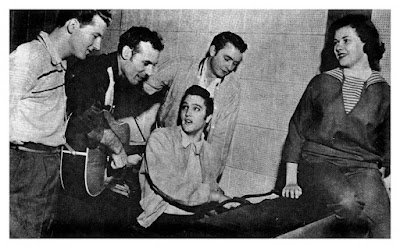
Here's a brief background of that well-known occasion: On December 4, 1956, Carl Perkins was at the Sun Records studio to record what was to be his latest single, "Your True Love/Matchbox." Joining Carl's band on the session was newly-signed Sun artist Jerry Lee Lewis on piano. Fellow Sun artist Johnny Cash was apparently already at the studio and when former Sun artist Elvis Presley showed up, you had a Million Dollar Quartet!
The guys held an impromptu jam session, which was fortunately recorded and has been released in various forms over the years.
Befitting the holiday season, one of the songs was an instrumental of the perennial "Jingle Bells":
Of the big four, only Carl Perkins on guitar and Jerry Lee Lewis appear on the track, with Carl's band providing backing.
It's pretty cool how they can pull off such a fun impromptu performance.
You can read all about that momentous day and hear all the songs all over the place.
One thing of note is that Elvis brought his current girlfriend, Marilyn Evans, along and you can see her in some of the photos - especially if they're not cropped:
Since we're hanging around the Sun studio, let's jump ahead to 1960 for this medley of Christmas songs released under the title of "Yulesville, U.S.A" by the Rockin' Stockin' which naturally includes "Jingle Bells":
Pretty fun take by the studio group lead by Billy Lee Riley!