Showing posts with label Andrews Sisters. Show all posts

Wednesday, July 8, 2026

Word Association Wednesday: A Modern Fairy Tale


To spin off Boy Meets Horn for this week’s Word Association, my wheels were turning for another tune with meets in the title — ideally something from around 1938. The obvious choice (to me, anyway) was the pop song When a Prince of a Fella Meets a Cinderella, subtitled A Modern Fairy Tale.

The Sisters Shine


The most popular version was by The Andrews Sisters on Decca:

This was early in the Andrews Sisters’ career, but their sound was already remarkably well‑formed — tight harmonies, crisp swing, and Patty unmistakably out front.

Bunny at the Ball


The tune also found its way to Bunny Berigan, who recorded his version for Victor with vocalist Jayne Dover:


No doubt that Bunny was assigned that song to record and wouldn't have picked it himself, but the band does a good job and Bunny’s trumpet is always great.

We had previously heard Jayne with Will Hudson, and she sang with a few other bands. An underrated canary!

Kay in the Court


Perhaps a more likely candidate to record this “Modern Fairy Tale” was Kay Kyser, who cut it for Brunswick with Harry Babbit:


The band was still leaning into the sweet‑band formula at this point, but their records from this era are consistently pleasant, and Harry's warm, easy delivery is a highlight.

Busse’s Ballroom Shuffle


We have one more record, this one by Henry Busse for Decca with vocalist Skip Morr:


I like the shuffle rhythm and always enjoy Henry’s muted trumpet.

Gracie's Glass Slipper


The first version of the song that I ever heard was not from a record, but from a radio show — The George Burns and Gracie Allen Show. Gracie sang the tune on the show from October 7, 1938:

At that time, the show was more of a variety format than the later sitcom style. George and Gracie weren’t portrayed as married yet, and Gracie was written as a bit man‑crazy. She often got a song, and her take on Prince of a Fella is pure Gracie: sweet, slightly off‑kilter, and completely endearing!

Oh, and I wasn't actually around in 1938 — I had an LP that featured a recording of that show!

Avery’s Animated Afterparty

1938 also brought us a delightful entry from Warner Bros.’ Merrie Melodies series: Cinderella Meets Fella, directed by Tex Avery. It’s full of Tex’s trademark wackiness and features an embryonic version of Elmer Fudd — still in full Egghead mode!

Cinderella and her fella were having quite a year in 1938 — on records, on the radio, and even in the cartoons. A modern fairy tale indeed!


Sunday, January 28, 2024

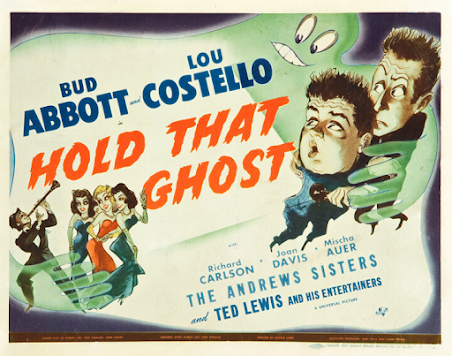
"Hold That Ghost" (1941)


Continuing to review the movies of Bud Abbott and Lou Costello, we hit "Hold That Ghost" from Universal in 1941!

As I mentioned last time, this movie (with the working title of "Oh, Charlie") was put on, well, hold in order to let "In the Navy" released as quickly as possible.


Despite their ample screen time in "In the Navy" and "Buck Privates," this is really the first film that lets the boys carry the main plot. It's kind of like instead of them being the comedy relief, there's now romance relief in support of the comedy!

(left to right) Joan Davis, Evelyn Ankers, Richard Carlson


The romance is supplied by Richard Carlson, who like Bob Cummings from "One Night in the Tropics," looks about the same here as he did in the mid-1950s and the lovely Evelyn Ankers, who was in a ton of movies for Universal, including "The Wolf Man," also from 1941!

Bud and Lou also get a solid comedy partner in Joan Davis, who has great chemistry with them, but apparently Lou thought she was a little too funny and was threatening to steal the picture!

But "Hold That Ghost" is a really fun movie and there are plenty of laughs to go around!

Joan Davis is definitely in this deleted scene from the original ending!

There's some controversy as to whether Joan Davis appears in the newly filmed ending. You see what would appear to be her character, but only from behind and she doesn't speak, so you'd think it was a stand-in, but some sources say it was her, but she was facing the wrong way. I know Universal was cheap and didn't like retakes, but wouldn't director Arthur Lubin had yelled, "Hey, Joan! Turn around!" or something?


Apparently Universal thought they should add some music to the movie while they were retooling it, so they filmed some bookends with the Andrews Sisters, since they had gone over well in the two service comedies.

Also featured in the musical portions is the very shticky Ted Lewis, a veteran bandleader who even by 1941 standards must have seemed dated. 

Ted does a couple of his old songs, including the so-non-PC-you-can't-believe-it-was-acceptable "Me and My Shadow" routine. Times were different, to be sure.

Anyway, the Andrews Sisters sing the main (only?) new song from the film, "Sleepy Serenade." which they naturally recorded for Decca:


Something of a contrast from the boisterous Don Raye songs from the earlier films!

And note how it says the song is from the New Universal Picture "Oh, Charlie" on the label!

Here's a version by Vaughn Monroe on Bluebird:


I've said before that it's interesting how Vaughn's early, pre-recording ban records are much more like "regular" band records than his later records which were more like vocal records, in keeping with changing musical trends.

"Sleepy Serenade" was also recorded as an instrumental by Claude Thornhill for the Okeh label:


A typically gorgeous arrangement from the Thornhill band. So underrated!


The Andrews Sisters also sing "Aurora" in the movie, although I think they had recorded the song earlier and it was shoehorned into the movie.

Here's their recording on Decca:


Interestingly, Decca had three other versions of the song (none of which mention the movie on the label), so let's hear them too!

Jimmy Dorsey recorded a lot of Latin-tinged songs, usually featuring Bob Eberly and Helen O'Connell, but only Helen appears on this:


Interesting. I have to say that I really don't care for Helen O'Connell's vocals on the whole. She was popular, though!

The Latin flavor continues with Pancho and his Orchestra:


A "Samba March," eh? Love it!

Then there's this off-beat polka version by "Happy" Harry Harden's Musette Orchestra:


That's awesome! I just love the muted trumpet!

Interesting that Pancho and Harry only use limited group vocals!

All in all, a really fun flick with reasonably entertaining tacked-on musical numbers!


Sunday, January 21, 2024

"In the Navy" (1941)


Our next movie starring Bud Abbott and Lou Costello is 1941's "In the Navy" from Universal Pictures!

This film followed hot on the heels of "Buck Privates" as Universal wanted another service comedy with the boys as soon as possible. As I understand it, "Hold That Ghost" was put in hold and "In the Navy" was filmed and released quickly.

The unusual opening credits make the connection quite clear!

Bud and Lou are in top form with many very funny routines, so this is a fun movie, although I feel it doesn't zip along as well as "Buck Privates," but few do!

This movie is unusual for A & C as it's really the only one to co-star them with a real actual movie star, in the person of Dick Powell, who's billed above the title with them!

I talk about Dick Powell all the time and about his transition from romantic crooner to hard-boiled tough guy and "In the Navy" is late in the crooner period. Is it a coincidence that Powell's character is a populaur crooner who's tired of being a crooner? Hmmm...

This was probably not the type of role that Dick was looking for in 1941, but he was a pro and does a good job as always.


Claire Dodd plays the love interest and she does a good job with an oddly written part.

It's interesting to see Dick Foran in a similar supporting role as he had in the earlier "Shipmates Forever from Warner Brothers in 1935, a movie that also starred Dick Powell. 

Dick Foran was later the male lead in a couple of A & C movies.

The Condos Brothers dance duo show some fancy steps, but the obnoxious Universal kid comedy team of Butch & Buddy also show up, not helping the proceedings!

The Andrews Sisters return to sing some numbers and they're good while singing, but can't act at all, although Patti has an expanded role as Lou's love interest.

Onto the  songs, which were again supplied by Don Raye, but with Gene DePaul this time.

Dick Powell sings the ballad "Starlight, Starbright" in the movie, but wasn't making records at that time, so we'll hear Dick Jurgens and his Orchestra with vocalist Harry Cool on Okeh records:


I always enjoy the Dick Jurgens band and although I miss star vocalist Eddy Howard, Harry Cool is pretty good too!

The Andrews Sisters get another snappy number, the not-overly-PC "Gimme Some Skin, My Friend," which they recorded for Decca:


That's the sort of song that I don't think was meant to be offensive, and I don't think it really is, but times were different then.

The Decca Band with The King's Men return with the (more or less) title song:


So, some good stuff!


Sunday, January 14, 2024

"Buck Privates" (1941)


As we continue to review the films of the comedy team of Bud Abbott and Lou Costello, we hit pay dirt with Universal's "Buck Privates" from 1941!

This is the movie that established the team as a box office sensation, leading to a long line of movies.

I love everything about this movie and it's just a blast!

Bud and Lou are the comedy relief, but they get a bigger storyline than they did in the previous year's "One Night in the Tropics" and they make the most of it.

(Left to right) Lee Bowman, Jane Frazee, Alan Curtis


I like the straight romantic plot too, as I think Lee Bowman, Alan Curtis and Jane Frazee are perfectly cast. Along with Nat Pendleton as the tough sergeant, this is probably the strongest cast of any A & C movie.

I like how the movie is filled with familiar character actors from Shemp Howard down to Tom Tyler (in a bit as the boxing referee).

And the music is great! I know a lot of modern viewers don't like the musical numbers, but I'm a fan of 1940s  music anyway and I like how this movie offers up a total entertainment package and can understand why 1941 audiences went crazy for it!


The top song is the Oscar nominated "Boogie Woogie Bugle Boy" by songwriters Don Raye and Hughie Prince (who appear in the movie as fellow recruits) and sung by the Andrews Sisters!

It's probably the most famous song from an Abbott & Costello picture and is also one of the Andrews Sisters' best remembered numbers.

So here are the girls on Decca Records:


So much fun!

Don Raye and Hughie Prince had previously collaborated with drummer/vocalist Ray McKinley on the hit song "Beat Me Daddy, Eight to the Bar" and "Buck Privates" included a follow-up, "Bounce Me Brother with a Solid Four," which the Andrews Sisters also performed in the film.

But let's hear Ray sing it with Will Bradley on Columbia:


The Bradley/McKinley band was great band while it lasted!

Another song from "Buck Privates" was "You're a Lucky Fellow, Mr. Smith," which the Andrews Sisters sang as part of a production number.

Let's listen to the Decca recording by the Decca Band with The King's Men (of "Fibber McGee & Molly" fame):


Fun to hear it as a march! 

The Andrews Sisters also performed their version of the then-oldie "I'll Be with You in Apple Blossom Time," which they also recorded for Decca:


A couple of other Raye/Prince songs, Jane Frazee's "I Wish You Were Here" and Lou Costello's specialty "When Private Brown Becomes a Captain" don't seem to have been recorded, but are effective in the movie.

Lots of fun!


Friday, February 11, 2022

"Winter Wonderland" - Part 3 - The Revival!


So, we heard a bunch of versions of "Winter Wonderland" from the song's initial period of popularity that followed its publication in 1934.

It seems that the song was then largely forgotten, as is the case with most popular songs of the day, as new songs came along. It certainly was a long way from becoming the perennial seasonal standard that it's become.

In fact, I don't the song was recorded for another ten years or so after 1935, but it came back in a big way after WWII was over.

For some reason (maybe post-war audiences were nostalgic?), 1946 saw three new popular versions of "Winter Wonderland" on major labels!

Leading the way was Johnny Mercer on Capitol Records. We heard it back here, but let's listen again:


Nice, mellow vibe from Johnny with the Pied Pipers and Paul Weston's orchestra.


Perry Como had the swingiest take on the song on RCA Victor, which we first heard back here, but it's definitely worth another listen:


That's probably my favorite vintage version. I like how the Satisfiers are billed right up there with Perry!


Decca Records also got in on the act with the original "Winter Wonderland" hit-maker, Guy Lombardo, teamed with the Andrews Sisters:

This was the flipside of "Christmas Island," making for a popular record.

I think the Lombardo band sounds less Lombardo-ish here, giving a nice background for the Sisters.

They include the rarely heard verse in the middle, which is fun!

With these three records all selling well and the business of seasonal records getting bigger and bigger, "Winter Wonderland" was on its way to becoming a seasonal perennial!


RCA Victor was back in 1947 with Sammy Kaye's recording as part of the ten-inch album "Year 'Round Favorites":


That's old school "Swing and Sway" with the singing song title at the beginning and vocalist introduction by Sammy in the middle!

Also in 1947, as we heard here, the small Signature label released a great version by Johnny Long and his Orchestra with vocalist Francey Lane:

Love it!

It took a couple of years for the other major record label, Columbia, to get with the program, but in 1949 they released this fine version by Buddy Clark:


Good backing from the Girl Friends and Ted Dale's orchestra.

This was paired with "Merry Christmas Waltz" and was also recorded at Buddy's last studio date.

Lots of good music in the post-war Winters!

Thursday, December 16, 2021

1940s Christmas Playlist - Part 16 - "Sleigh Ride"


We move into 1949 proper with our Christmas music playlist, where we have more songs by far than any other year of the 1940s!

I think that by the time 1949 rolled around, there were so many fairly recent holiday/seasonal songs, led by "White Christmas," that had proven successful, the song publishers and record companies were eager for more product.

From a seasonal-but-not-holiday standpoint, few songs are as popular as Leroy Anderson's "Sleigh Ride."

1949 saw its initial recording, which was by the Boston Pops, conducted by Arthur Fiedler on the fancy RCA Victor Red Seal label:


That's just awesome and still sounds great! You usually hear the 1959 stereo version by the Pops, but you can't beat the original!

Composer Anderson (left) with maestro Fiedler.


Fiedler and the Boston Pops introduced several of Leroy Anderson's pieces before Anderson started his own successful recording career. He recorded his own version of "Sleigh Ride" for Decca Records in 1950:


Sounds good!

The year 1950 also saw lyrics added to "Sleigh Ride" courtesy of  Mitchell Parish and versions with vocals started appearing.

I think the first was this cut by the Andrews Sisters, also on Decca:


That doesn't seem like a typical Andrews Sisters record to me, as there's a backing chorus and the girls are relatively subdued. Nice, though!

I really like the version that Freddy Martin (again with young Merv Griffin) recorded for RCA Victor in 1950:


The Martin band was always good at adaptations of classical music, so a light concert piece like "Sleigh Ride" is in their wheelhouse!


We'll stick in the 1950s for a couple of other versions, including this one from alto saxist Herb Geller on Mercury's Emarcy label in 1954:


Pretty cool!

Then there's this vocal version by Johnny Mathis from his 1958 "Merry Christmas" album on Columbia:


Other than the Boston Pops' version, Johnny's may be the one I've heard the most over the years.

You sometimes hear the birthday party mentioned in the song turned into a Christmas party in an attempt to give it more of a holiday feel. I think the first recording to do so was by Walter Schumann on his 1955 "The Voices of Christmas" LP on RCA Victor:


That's a bit square for my taste, but OK.

Then there's Jo Stafford's version on her 1956 Columbia album "Ski Trails." That changes the whole Currier and Ives thing, which is the only such version to do so of which I'm aware:


That's more my style!

Lots of additional recordings of the song have followed, with it being adapted into different styles, which I don't think always fit!

That being said, the Ventures had a great version in 1965, which you can hear here!


Wednesday, December 8, 2021

1940s Christmas Playlist - Part 8 - "Here Comes Santa Claus" (1947)


Our 1940s Christmas music playlist moves into 1947 and we run into another big one: "Here Comes Santa Claus" by Gene Autry!

Here's Gene's original on Columbia Records:


That, to me, is the goods! I think everything comes together on that record. The song, the vocal, the western swing band, the sleigh bells. It's very high on my list of favorite holiday recordings ever!


In retrospect, it was something of a milestone as in addition to introducing a much-recorded standard, it was Gene Autry's first Christmas recording and set the stage for his encounter with a particular reindeer a couple of years later!

The record was very popular, but as Gene was co-writer and publisher, he was the only artist to record the song for 1947, but for 1948 there were competing versions by country and western artists Jesse Rogers on RCA Victor and Cliffie Stone on Capitol with Red Foley joining in on Decca in 1949. All good!

It was 1949 that saw the song first appear in non-country versions by other artists.

A popular version was by Bing Crosby and the Andrews Sisters on Decca:


I like that version well-enough and appreciate the extra little "happy days" and whatnot flourishes, by I feel like they don't take the song seriously enough. I know it's a novelty song, but I like my novelties respected, you know?

That brings us to this 1949 recording by Sammy Kaye's band on RCA Victor:

Now, that's a novelty arrangement for sure, but it's sincere. I know that Sammy Kaye is largely dismissed as a corny musical lightweight when thought of at all these days, but he took his business seriously and his groups were always totally professional.

One more 1949 version was from new solo star Doris Day on Columbia Records:


Always good to have a cameo from Mr. Claus!

Once the 1950s rolled around, the floodgates really opened for "Here Comes Santa Claus" and it's been recorded by all sorts of artists in all sorts of styles.

For my dough, though, you can't top the Singing Cowboy!


Monday, December 6, 2021

1940s Christmas Playlist - Part 7 - "Christmas Island" (1946)


Still in 1946 with our Christmas music playlist, we come across a semi-standard - "Christmas Island!"

This song is not nearly as well-known as something like "White Christmas," but there have been enough versions over the years to keep it from obscurity.

It was introduced on a Decca record teaming up two of the label's most popular artists: The Andrews Sisters and Guy Lombardo:


You know right from the start that it's Guy Lombardo's Royal Canadians playing and you can't mistake the sound of the Andrews Sisters, so a listener in 1946 didn't even need to look at the label to know who was on this record!

I've had a copy of the 78 for I don't even know how long and always thought it was a fun song. Back in those days it was hard to find out anything about anything, but I later did learn that it was a popular release.

I confess that back in the day I was somewhat annoyed by the corny and dated-even-by-1946 Lombardo sound, but years later I find it sort of charming!

For whatever reason, the other big labels (RCA Victor, Columbia, Capitol) didn't have any of their artists record the song at that time, which was often the case, so I don't know how it wound up at Decca.

The only other version I can find that I think is contemporary (probably 1947) is on the small Coast Records label by Jack McLean and his Orchestra:


That label just screams period charm! And Down Melody Lane with Jack McLean? I'm in!

The band certainly has a Lombardo sound to it and from hearing the other occasional Jack McLean records, it was definitely a sweet band.

We had actually run into vocalist Wayne Gregg back in 1936, singing with the Riley-Farley band. Wayne was with the McLean band when they cut some early Capitol records back in 1942, so if he was still with them in 1947, it must have been a pretty good gig!

Anyway, for some reason, "Christmas Island" had a mini-revival as a country-tinged song in 1950, with a couple of new recordings.

Here's the Dinning Sisters with country singer Bob Atcher on Capitol Records:


They definitely go for a more tropical vibe, but Bob Atcher has a singing cowboy sound, yet it works!

Interesting to see the sisters' names all spelled out on the label instead of as "The Dinning Sisters," especially if they were Capitol's answer to the Andrews Sisters!

For even more of a country feel, superstar Ernest Tubb recorded the song for Decca:

I cannot tell you how much I love that the female backing vocal group is named the Troubadettes! See, I'm well aware that Ernest Tubb was nicknamed the Texas Troubadour, so I totally get it!

It may seem like an odd song choice for E.T. to record, but it somehow suits him!

The song has been recorded here and there over the years and even served as the title track on holiday albums by Leon Redbone and Jimmy Buffet, who have their own fan bases to keep the song alive. Bob Dylan even cut a version!

Jimmy Buffet included the seldom-heard verse on his version, but I think the earliest to do so was British singer Dickie Valentine in 1956 on British Decca:


I like Dickie Valentine's Christmas records, which were apparently very popular in England, but perhaps not issued in the U.S. back then?

Note to self: I feel like I'm using the word "version" too much. Where's editor Slugger?

Popular (For Some Reason) Posts: