Day 20 of our Christmas Countdown finds another rare holiday song, 1939's "When Christmas is Gone" by Connee Boswell!
Her Decca record of this song which she co-wrote might be the only recording of it, so let's give it a listen:
That's really nice! She was a wonderful singer!
I also dig the spare instrumental accompaniment!
Note that Connee was still "Connie" at this point in her career. The story goes that she was so popular with G.I. audiences during WWII that she adopted the new spelling of her name so she could sign autographs more efficiently without needing to dot the I!
We meet up with another popular female vocalist of the 1950s - Gisele MacKenzie, the Canadian-born star of TV's "Your Hit Parade!"
Here's her version of "Jingle Bells" on Vik Records (a subsidiary of RCA Victor) in 1957:
That's a fun arrangement. Love the "Mush!" at the end!
The flipside of that single is this novelty number:
Santa's avoirdupois really takes a beating here, with Gisele really emphasizing "fat" quite strongly!
Gisele MacKenzie recorded "Too Fat for the Chimney" in 1957, but the song had been around since 1953, as we heard in Teresa Brewer's version from that year.
I don't think it was typical for a song that had been around for a couple of years but didn't garner too much attention to be released as a new single, but there you go!
Interesting that it was written by Irving Gordon, best-known for "Unforgettable," the great Nat "King" Cole hit from 1951!
"Billboard" gave the two sides a favorable review in the November 25, 1957 issue, acknowledging that "Too Fat" was revived:
I always find it interesting to follow the path of certain recordings as they're issued and reissued in different formats and Gisele's version of "Jingle Bells" got around a little bit.
In addition to the single, it also appeared on this Vik EP in 1957:
"Too Fat..." didn't make the EP, but it was included on the LP, also from 1957:
The the album was re-released in 1959 on the parent RCA Victor label, with a slightly altered cover:
There was also this promo 45 rpm record, which I'm guessing was from 1957:
RCA loved the red and green type on white labels for the Christmas promo records!
Since I'm always trying to connect everything, Gisele MacKenzie and Jo Stafford are at most one degree apart as they at one point alternated as the female vocalist with Bob Crosby on his "Club 15" radio show:
Gisele on the left, Jo on the right
Gisele's biggest hit was "Hard to Get" on "X" Records (another RCA subsidiary) in 1955:
I think people these days think that there was a seismic shift in popular music about 1955 with "Rock Around the Clock" and the like elbowing out the pop vocalists, but Gisele's number-two hit shows it was more gradual!
Gisele was also a talented violinist and she often performed duets with her mentor, the not-quite-as-talented Jack Benny!
So far we've only had one song for each year from 1941 through 1943 and as we hit 1944, we again have only one song, but it's also a standard: "Have Yourself a Merry Little Christmas!"
The song was introduced by Judy Garland in the MGM movie "Meet Me in St. Louis" as part of the topnotch score by songwriters Hugh Martin and Ralph Blane.
Judy was under contract to Decca Records at that time and recorded her version for the label:
That's really nice!
Actual film soundtracks weren't much of a thing at the time, but this sounds a lot like the movie version, no doubt because Georgie Stoll provided the backing and he worked on a lot of movies for MGM, including several with Judy.
For a long time the only version of the song I would see reissued on CDs and such was apparently an alternate take in which Judy mixed up "near to us" and "dear to us" and you still need to listen carefully to see which one you're getting!
To put the song in its original context and account for the melancholy tone, here's a clip from "Meet Me in St. Louis" with Judy singing the song to her "sister" Margaret O'Brien:
This was my mother's favorite movie and she loved Margaret O'Brien, who was about her age!
A lot has been said about Judy Garland and her various issues, but my take is that she was a wonderful singer and actress and I can enjoy her movies by not thinking about any extra baggage, you know? For any form of pop culture, I try to place myself in the era.
In any event, although "Have Yourself a Merry Little Christmas" has evolved into a standard, there were no other recordings of the song in 1944 (RCA Victor and Columbia were still locked out for most of the year). "The Trolley Song" was the one that got all the attention, with it's totally opposite joyful tone.
I think the next recording of "Have Yourself..." was a few years later in 1947by Frank Sinatra for his 78 rpm album "Christmas Songs by Sinatra":
Nice version and we'll get back to Mr. Sinatra in a minute.
There was one other recording of the song in the 1940s, this one from 1949 by Margaret Whiting on Capitol Records:
Totally solid and I think Margaret Whiting was a great singer, but it doesn't add enough to make it essential listening.
Those three records appear to be the only mainstream versions of the song from the 1940s. There was never a big band version.
It's interesting that the first big Christmas standards of the 1940s, "White Christmas," "I'll Be Home for Christmas" and "Have Yourself a Merry Little Christmas," all have a wistful, melancholy tone in their original versions, which I guess you can chalk up to WWII.
Flash-forward to 1957 when Frank Sinatra was preparing his "A Jolly Christmas" album and wanted to include "Have Yourself a Merry Little Christmas" but didn't think the song was jolly at all (can't argue that!)
So the story goes that Frank got in touch with Hugh Martin who revised the lyrics to make it the happy song about enjoying the present that we all know now!
Here's Frank's 1957 version:
I submit that although the new lyrics are much more positive, this recording is still not particularly jolly! The whole album isn't really that jolly!
When I first heard the story a number of years ago that Hugh Martin himself was responsible for the lyric change, the purist in me stopped being annoyed!
You can also check out Dinah Shore's excellent 1957 version with the brand-new lyrics here.
Let's throw in this in-between version of the song. It was cut by Joni James as the title track of her Christmas EP for MGM records in 1955, before the lyric change:
I think that's a great version and it sounds more hopeful and less wistful than any other pre-1957 recording!
The songs from the EP were incorporated into a full-length LP the next year and that sports a much more attractive cover:
Nowadays there are so many versions and some mix the old and new lyrics (just sloppy work sometimes), but it's a great standard whatever the case!
Our Christmas music playlist moves into 1943, which was another lean year due to the ongoing recording ban, but we do have another bona fide classic courtesy of Bing Crosby - "I'll Be Home for Christmas!"
Fortunately, Decca Records settled with the musicians' federation in 1943, so Bing was able to record the song in time for the holiday season:
The song has been recorded by a ton of artists in the ensuing years, but when you think of it in its original context in the middle of WWII, it's even more poignant.
I like the guitar part by Perry Botkin, who was another regular of the John Scott Trotter studio orchestra and played on some early Spike Jones recordings. (Yes, it does always come back to Spike Jones!)
Billboard's review is very positive and also alludes to the recording ban:
Due to the strike not being settled yet by the big-name RCA Victor and Columbia Records, they couldn't record any of the bands that they had under contract, so they weren't able to jump on the song.
This brings us to an interesting contemporary recording on the Hit Record label:
I like that the rarely-heard verse is included, but the whole thing screams low-budget. Underwhelming in performance, arrangement and recording.
But I'm glad these records exist, as they are sometimes the only fully-orchestrated commercial recordings of songs from the era.
A somewhat burning question is whether the "Sid Peltyn" who's credited as the bandleader was a real person? Or was it a pseudonym? And who sings the vocal? Nobody knows!
In any event, once the holiday season of 1944 rolled around, "I'll Be Home for Christmas" was basically just a song from last year and hadn't become a standard yet.
It started to get recorded a bit more as the decade rolled on an Christmas recording were becoming increasingly popular, including albums, which necessitated the need for more songs. Perry Como included a fine version on his 1946 Christmas album:
But I think the only real, honest-to-goodness big band version of the song from the post-war 1940s was this 1947 release on Majestic Records by singing bandleader Eddy Howard and his Orchestra:
Always a fine job!
As the years rolled along, more and more versions of "I'll Be Home for Christmas" were recorded and it seems everyone is familiar with the song these days.
You know what bugs me, though? So many versions alter the line "And presents on the tree" to something with another preposition like "under the tree" or "by the tree" or something!
Oh, well!
Note: I didn't forget that I had mentioned Bing's record in this post, but it was something of an afterthought and felt it needed more recognition.
As we move into 1942 with our 1940s Christmas music playlist, we hit the big-time with Bing Crosby and "White Christmas!"
Bing introduced the song in the Paramount picture "Holiday Inn" and it won the best song Oscar for composer Irving Berlin and Bing's record became the biggest hit ever!
Let's give a listen to Bing's original recording on Decca Records:
Sounds good!
Tommy Dorsey, John Scott Trotter and Spike Jones seem amused with Bing's attempt at drumming!
A fun note is that the drummer in John Scott Trotter's orchestra was Spike Jones! He played with Trotter on Bing's "Kraft Music Hall" radio show and Bing's recording dates before the City Slickers took off and became Spike's full-time job!
This original record was a game-changer in that it was so popular that it made the record companies realize that there was a lot of money to be made in seasonal records, although it seemed to take a bit of time for them to realize that other holiday songs besides "White Christmas" could be hits as well!
An interesting note is that Bing re-recorded the same arrangement of "White Christmas" in 1947 and that's the version that's been most commonly (practically exclusively) heard over the last 75-ish years.
The original recording has resurfaced here and there in the past 20-odd years or so, but for a long time you had to have the 78 to hear it!
I hear/read different things about why it was re-recorded. Maybe that the original master was worn out from the record being reissued so much. Maybe there was something that Bing didn't like in the original and thought he could do it better.
Whatever the case, here's Bing's familiar 1947 remake:
I guess you can play "spot the difference," but they're pretty close!
Going back to 1942, there were some other recordings of "White Christmas" that year, but the recording ban that went into effect on July 31st of that year limited the number of other versions.
There was a great version that made it under the wire, though. It's by Charlie Spivak and his Orchestra on Columbia Records, featuring vocalist Garry Stevens:
I'm extremely partial to vintage "dance band" records, so I love this one!
Charlie Spivak was another popular leader who I think had an underrated band. He was a tremendous "sweet" trumpeter (not a jazz soloist) with a great tone. And I think Garry Stevens was an excellent band singer.
Once the recordings ban was settled, there were more recordings of "White Christmas" and new ones still come out every year.
A good one from 1947 was this version by Eddy Howard and his Orchestra on Majestic Records:
As I mentioned when discussing Eddy's record of "Ebenezer Scrooge" a while back, I think he was a terrific singer and I really appreciate that he kept a band going into the 1950s to back him on his many hit records.
The Drifters
I think the most famous version next to Bing's is the 1954 recording by the Drifters, featuring Clyde McPhatter (in center of above photo) and Bill Pinkney (at left in photo and name spelled incorrectly on record label!) on Atlantic Records:
That cut has been reissued a zillion times in the last 30-odd years since CDs came along, and I can hear the influence of the Drifters version in "White Christmas" recordings from Elvis Presley to Michael Bublé, but there was a time when you had to have the 45 or 78 to hear it, and I thought I was really hip to be onto it!
The Ravens
That being said, I was astounded later (but still 30-odd years ago) to come across this 1948 recording by the Ravens as released on National Records:
Isn't that the craziest label credit ever? "The Raven's Rendition of: White Christmas." It's a copy editor's nightmare!
Whatever the case, there's no doubt the Drifters record is totally based on that Ravens arrangement.
I will say that the Drifters sound more polished and Clyde McPhatter is a zillion times better than Ravens tenor Maithe Marshall (bottom middle of above photo, but the bass singing of the Ravens' Jimmy Ricks (at top in photo) is absolutely tremendous!
I dig both records!
For one more version, let's go to 1959 for Esquivel with his "space-age" cut from RCA Victor's "The Merriest of Christmas Pops" LP:
That is pretty merry!
But Bing Crosby and "White Christmas" still sit at the top of that Christmas music mountain almost 80 years later!
Now that the calendar has turned to December and Thanksgiving is about a week behind us, you'd have to really be a Scrooge not to admit that the Christmas season is upon us and the air should be filled with Christmas Music!
As an aficionado of Christmas/Seasonal music, I think the real heyday for new songs was the 1940s, so with that in mind, from now until Christmas, I'll be sharing some of my favorite songs/records!
One thing to keep in mind is that I'm only counting songs that were introduced in the 1940s, so while there were solid renditions of, for example, "Santa Claus Is Comin' to Town" and "Winter Wonderland" cut in the 1940s, those songs are from the 1930s and won't be on the list.
Also, in order to get more songs in here, I won't include any that I've already spotlighted, including some biggies like "All I Want for Christmas is My Two Front Teeth" by Spike Jones. But I'll mention them as we go along.
I'll go in chronological order by year and won't go too far off-topic, but I'll add my usual this and that as we go!
So, without further ado, we start off in 1941, with a mood setter; "Snowfall" by Claude Thornhill and his Orchestra on Columbia Records:
I think that's just a tremendous record!
"Snowfall" was the theme of Claude Thornhill's band and it was written by the enigmatic pianist/arranger/bandleader.
If pressed, I might say that the Thornhill band was the most underrated of its era. It had a unique sound and was great at creating moods.
Here's another record by the band, this one from 1942:
Two things about this record of "There's a Small Hotel" that make me feel smart: The first is that I recognize the little snippet of "Snowfall" at the very beginning and the second is that I "get" that the vocal group is called "The Snowflakes" because of the band's theme!
If you ever need help with 80 year old pop culture trivia questions, I'm your man!
Anyway, I don't think anyone else recorded "Snowfall" in the 1940s, as one band wouldn't record another band's theme song unless that song was a big hit song on its own.
It seems that "Snowfall" had to wait until the mid-1950s when there were a lot more LPs coming out to garner non-Thornhill recordings.
I think the first mainstream album to use "Snowfall" as a seasonal tune was Jackie Gleason's 1956 "Merry Christmas" LP on Capitol records:
The haunting arrangement rivals Claude Thornhill's own!
Also recorded in 1956 was this very different take by Pete Rugolo on his Mercury LP "Music for Hi-Fi Bugs":
That's a very cool mid-1950s sound, but those bugs are too realistic!
At some point "Snowfall" acquired lyrics, which I understand were written by Ruth Thornhill, Claude's wife.
The first instance of a vocal arrangement I can find is also from 1956, on the "Winter Wonderland" LP by the Ray Charles Singers on MGM Records:
That's very nice, sticking fairly close to the original.
I see that Mr. Charles is credited as one of the songwriters on the label, not sure what that's all about.
In any event, Claude Thornhill must have enjoyed the royalty checks he started getting in 1957!
As we continue with "Jingle Bells," we come across one of Jo Stafford's main competitors fro the top female vocalist of the nebulous post-big band/pre-rock & roll period: Patti Page!
Patti was extremely popular and prolific recording artist, so it must come as no surprise that she has a number of Christmas songs in her discography.
Her first Christmas LP was the ten-inch "Christmas with Patti Page" on Mercury Records in 1951. It included her version of "Jingle Bells":
The flipside of the 78 from the set was "Christmas Choir":
Patti was a natural for a song like "Christmas Choir" as many of her records featured the new-fangled technique of multi-tracking her voices.
Mercury had fun with the labels, as the "Christmas Choir" label saying the vocal is by "Patti Page, Patti Page, Patti Page, Patti Page" to let us know how many Pattis are on there!
I don't know too much about the logistics, but I don't think just anybody could pull off the overdubbing, so it shows Patti's talent that she was able to sing harmony with herself.
The main competitors of the technique at the time were Les Paul and Mary Ford and we all know what a technical whiz Les was!
I had mentioned before when talking about Mabel Scott's record of "Boogie Woogie Santa Claus" that Patti Page had recorded a version of that sing in 1950 as the incongruous flipside of her mega-hit "The Tennessee Waltz."
Mercury Records apparently thought about it and reissued "The Tennessee Waltz" with a non-holiday flipside. But since they already had "Boogie Woogie Santa Claus," they reissued that in 1951:
I think Patti's version is fine, but I like Mabel's better.
For the flipside of the reissue, they plucked "Christmas Bells" from Patti's Christmas album:
I really like that one a lot and it's long been on my early 1950s holiday playlist!
The original issue of Patti's Christmas album was the ten-inch version shown above, but in 1955 Mercury released an augmented version as a 12-inch album with what I think is a great mid-century modern looking cover:
I totally want to hang out with Patti at a Christmas party there!
Just a note that Patti was about ten years younger than Jo Stafford, so while the Big Band Era was still going on when she started her career and she did sing with Benny Goodman at one point, Patti came to fame as a solo artist with her records on Mercury rather than having made a national reputation as a band singer.
Patti switched from Mercury to Columbia Records in 1964 and recorded a new Christmas album (with a not particularly original title!) for her new label in 1965.
It included a new arrangement of "Jingle Bells":
Patti sounds good, but I can't really say I dig the children's chorus. I like it better when she accompanies herself!
The album yielded this inspirational song:
With a remake of "Christmas Bells" on the flipside:
As with most remakes, I prefer the original, but these newer recordings sound very much like what you would hear in the mid-1960s on the family stereo!
Before we go, we do need to hear "The Tennessee Waltz":
We continue just a little longer with the Perry Como connections as we check out a version of "Jingle Bells" from his co-star on "The Chesterfield Supper Club," the great Jo Stafford!
This cut is from her 1964 album on Capitol Records, "The Joyful Season":
That features multi-track recordings of Jo's voice, so the album is actually credited to the Voices of Jo Stafford!
She was no stranger to multiple voices, as she first rose to fame in the early 1940s as a member of the Pied Pipers vocal group with the Tommy Dorsey band and often featured vocal groups on her solo records.
"The Joyful Season" is a solid album and features snappy accompaniment from a combo led by Jack Marshall.
In keeping with the "Jingle Bells" theme, Jo included that song as the intro to her version of "Winter Wonderland" from her 1956 "Ski Trails" album on Columbia Records featuring the Starlighters vocal group and backing from Jo's husband, Paul Weston:
Such a great sound!
We continue to go backwards as we hit 1955 for Jo's album "Happy Holiday" as she reaches back to her Tommy Dorsey days for a quick version of "Winter Weather" also with the Starlighters and Paul Weston:
Really fun!
Let's go back even further to 1946 for Jo's first Christmas recording, a hit version of "White Christmas" for Capitol Records:
The flipside is a beautiful version of "Silent Night":
Paul Weston also leads the orchestra on those sides, but was not married to Jo Stafford yet. He had been an arranger with Tommy Dorsey, so he knew Jo from those days.
Tommy Dorsey conducts Jo Stafford with the Pied Pipers. That boy singer on Jo's left showed promise. Whatever happened to him?
Speaking of Tommy Dorsey, let's go to 1941 for TD's great version of "Winter Weather" on Victor Records featuring Jo as the lead singer of the Pied Pipers:
I think that's just a great record with the band in such good form playing Sy Oliver's arrangement!
I think these holiday/seasonal sides show Jo Stafford's talents quite well, but she also had a wacky side, which is at the forefront of this big 1947 hit by Red Ingle & the Natural Seven on Capitol Records:
That's Jo singing under the alias of "Cinderella G. Stump" with the novelty group Red formed after leaving Spike Jones & his City Slickers. "Naturally" I love this record!
A further Perry Como connection comes up in that Red Ingle and Country Washburne, the arranger of "Tim-Tayshun") had been longtime members of the Ted Weems band and the romantic boy singer at one point was Perry Como!
Still in the 1960s, we stop in the interesting musical year of 1967 for this single of "Jingle Bells" by the psychedelic group the Blues Magoos on Mercury Records:
The choice of the flipside harkens back to the 78 rpm era:
I find it interesting that the label uses the more formal "Coming to Town" vs. the original "Comin' to Town."
The Blues Magoos were best known for the top five hit "(We Ain't Got) Nothin' Yet" from earlier in 1967, so it's not like they were sticklers for grammar!
Here's that song:
They only had the one charting song, so chalk the group up as a memorable One-Hit Wonder!
What do you suppose the popular cartoon character would have thought of his last name being appropriated by such an aggregation?
We just heard Perry Como with "The Christmas Symphony," which leads to the obvious question of whether Perry ever recorded "Jingle Bells." The answer is of course he did!
Here's his 1946 recording issued on RCA Victor as part of the "Perry Como Sings Merry Christmas Music" album of 78s:
Nice version with solid backing from Russ Case!
That particular album yielded a separate single release with the new song "That Christmas Feeling" on the A-side:
The flipside is a swinging take on a by-then familiar standard:
Both of those sides have been mainstays on my 1940s Christmas playlist for years!
Another one of those retro-type things I feel smart about "getting" is that the backup vocal group was named the Satisfiers because they appeared with Perry on "The Chesterfield Supper Club" and, as we know, Chesterfields satisfy!
Perry Como recorded a lot of other Christmas songs and he also re-recorded some when stereo rolled around, but I think he only recorded "Jingle Bells" the one time.
But, RCA Victor got a lot of mileage out of it!
Perry released a Christmas EP in 1953 titled "Around the Christmas Tree":
The EP's leadoff track was a recitation of "'Twas the Night Before Christmas":
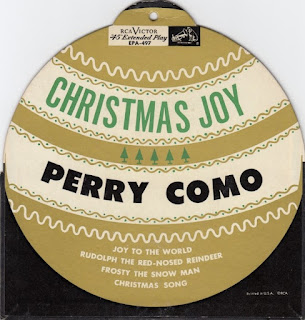
There was also another EP in 1953 with the title "Christmas Joy":
This included a version of "Frosty the Snowman":
The EPs featured backing from Mitchell Ayres, another frequent Como collaborator.
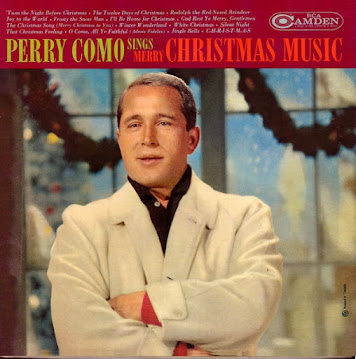
Seven of the songs from the original 78 rpm album were joined with the eight from the two EPs for the 1956 LP release retaining the 78 album title of "Perry Como Sings Merry Christmas Music":
Then RCA re-released that album with a new cover on their budget Camden label in 1961:
My family had that one (I still have it) and we played it a lot during the holiday season!
Another RCA imprint was the Bluebird label, which had been a lower-priced, but high-quality label in the 1930s and 1940s, but was later used for kiddie records in the 1950s.
RCA went old school and paired Perry's recording of "Jingle Bells" with his 1946 recording of "Santa Claus is Comin' to Town" (which didn't make it onto the LP) for a 1957 release:
Here's "Santa Claus is Comin' to Town":
More solid backing from Russ Case and the Satisfiers!
I think those two songs were first teamed up on as the B-side of a 1953 EP that had "The First Christmas" as the A-side:
That recording had been issued in as a two-sided 78 rpm record in 1950:
Here it is:
The year 1957 also saw this Australian release with a fun ornament packaging reminiscent of the earlier EPs:
It had "The Night Before Christmas" on one side, with "Jingle Bells" and "Frosty the Snowman" on the other.
Then from 1958 is this Italian release that put 1946's "White Christmas" with "Jingle Bells" inside the wacky sleeve:
Here's "White Christmas":
That features backing by Lloyd Shaffer and was the only track from the original 78 album not to feature Russ Case.
All of this just scratches the surface of Perry Como's holiday recordings, as he had many other singles and albums.