Showing posts with label Vaughn Monroe. Show all posts

Monday, September 14, 2026

Monday Side‑Session: We Got It Good


For today’s side‑session, we follow up on Duke Ellington’s
“I Got It Bad (And That Ain’t Good)” with ten contemporary covers from the 1941–42 period — a little cross‑section of how the tune moved through popular music right when it was new.

So, let's start spinning...


We start with Dinah Shore on Bluebird:

The tune fits early‑Dinah perfectly — that clean, youthful phrasing she had in the early ’40s.


Next up is Ella Fitzgerald for Decca:

Quite lovely. This comes from the period when Ella was still fronting the Chick Webb band after Chick’s passing, and you can hear that blend of band-singer polish and her emerging solo personality.


Then we have The Charioteers on Okeh:


A warm group sound with Billy Williams leading the way.


A number of bands also picked up the tune, usually with a canary handling the vocal. Here’s Benny Goodman with Peggy Lee on Columbia:

Typically solid work from Benny and Peggy — clean, poised, and right in their wheelhouse.


Jimmy Dorsey recorded his version for Decca with his star vocalist Helen O’Connell:


I think this type of song fits Helen better than the novelties she sometimes performed. JD’s alto is solid as usual.


Les Brown and Betty Bonney cut the song for Okeh:


Betty tends to be overshadowed by Doris Day in the Les Brown story, but she was excellent too — and this track shows it.


Bunny Berigan recorded his version with Lynne Richards for the small Elite label:

These relatively late records by Bunny are always intriguing — you can hear both the brilliance and the strain of those final years.


Next up is Vaughn Monroe, who had Marilyn Duke sing the vocal for Bluebird:


This is from the period when Vaughn was more of a bandleader who sang, rather than a singer who led a band, as I like to say, as he didn't sing on every record and also recorded instrumentals.


We get a rare male vocalist as Eddy Howard takes the vocal himself on his Columbia side:


Eddy, like Vaughn, had his greatest success post-WWII, as they were able to directly compete with the singers in a way most bandleaders could not.


The most intriguing contemporary cover to me is this version by Earl Hines on Bluebird:


What I find fascinating is the vocal arrangement: Madeleine Greene and the Three Varieties sing in the third person, while Billy Eckstine sings about himself having it bad. And that is good!

There have been countless remakes of “I Got It Bad” in the decades since, but these contemporary covers give us a snapshot of how the tune lived in its own moment — across labels, across styles, across the early‑’40s pop landscape.

We got it good!


Thursday, June 18, 2026

Threaded Thursday: Getting Lost


We pick up the word‑association thread and wander from Duke Ellington’s Lost in Meditation to the 1942/43 Frank Loesser–Jimmy McHugh charmer Let’s Get Lost.

The tune debuted on screen in Happy Go Lucky (Paramount, 1943), introduced by Mary Martin. Mary didn’t cut a commercial record, but a few bands managed to sneak versions onto wax just in time before the recording ban hit in 1942 for release in 1943:

Vaughn Leads the Way


Vaughn Monroe was first out of the gate, and his Victor release became the big 1943 hit:


A relaxed, conversational reading from Vaughn and the Four Lee Sisters — easygoing and elegant.

Kyser Keeps It Cozy


Kay Kyser followed with a popular version on Columbia, with Harry Babbitt joined by Julie Conway, Trudy Erwin, Jack Martin, and Max Williams:


The Kyser band was making some truly lovely sides in the early ’40s, leaving the ’30s novelty gimmicks behind.

Teddy & Peggy's Underrated Gem


The underrated Teddy Powell band turned in a Bluebird version featuring a lovely vocal by the equally underrated canary Peggy Mann:


This was the first version I ever heard — and it still might be my favorite!

Hallett Hits It


Another canary, Kay Marie Baird, is featured with Mal Hallett's orchestra on the Hit label:


The records from the Hit label can be "hit" or miss, but the ones featuring an actual name bandleader, such as Mr. Hallett,  tend to be pretty good. I think Kay Marie is also good, but all I really know about her is that she was the sister of the much more prominent Eugenie Baird.

Jimmy & Bob Step Up


Jimmy Dorsey’s Decca take features Bob Eberly in prime form:


When you hear Bob on a side like this, it’s easy to understand why young Frank Sinatra kept an eye on the competition.

Frankie on the Airwaves

By the time “Let’s Get Lost” hit big in 1943, Frank had left Tommy Dorsey and didn’t get a commercial recording — but he did sing it on Your Hit Parade:


The song fits early‑’40s Sinatra like a glove.


No wonder Olive Oyl swooned when Frankie sang it in the 1945 Paramount Cartoon Shape Ahoy!

Dinah Drops By


Staying in radio land, here’s Dinah Shore from the Eddie Cantor show:


Pure Dinah — warm, clear, and effortless. You can understand why she was on her way to major stardom.

Shep & Meredith's Encore

We had recently heard an aircheck of Meredith Blake singing Let's Get Lost with Shep Fields' all-reed band. Let's hear it again:


Still sounds great!

Adelaide Across the Atlantic


We do have one more 1943 studio version: Adelaide Hall on British Decca:


Another lovely, poised reading.

Chet Chimes In


After 1943, the tune went quiet for a while — one of those songs that had its moment and then drifted into the fog. But in 1955, Chet Baker brought it back on Prestige:


To be honest, I’ve never been fully sold on Chet’s vocal style, but he undeniably helped turn the tune into a modern standard. I'd say he's the artist most associated with the song.

Johnny's Jaunty Detour


And because I always like to slip in a snappy instrumental, here’s pianist Johnny Coates, Jr. from his 1960 Savoy album Portrait:


Snappy indeed — a bright little spotlight on the tune’s bones.

With guides like these, Let’s Get Lost never really got lost at all.


Wednesday, June 17, 2026

Word Association Wednesday: Another Place


We spin off Duke Ellington’s
If You Were in My Place and land squarely in the orbit of the 1941/42 hit Somebody Else Is Taking My Place.

Morgan’s Melancholy Manner


The song was co‑written by bandleader Russ Morgan, and he was the first to record it. Let’s drop the needle on his late‑1941 Decca side:

That’s classic “Music in the Morgan Manner” — the melancholy, sighing trombone, Russ easing into the vocal and The Morganaires wrapping it all in that soft‑focus harmony.

Peggy Perks It Up


But the definitive version arrived almost immediately afterward, when Benny Goodman cut it for Okeh with his brand‑new vocalist Peggy Lee:


The lyrics don’t brighten up any under Peggy’s delivery, but the record sure does. It’s crisp, swinging, and no mystery why it became the hit.

Label intrigue: Benny wasn’t being “demoted” to Columbia’s cheaper Okeh subsidiary. Glenn Miller was selling literal millions on Victor’s budget Bluebird line, so Columbia simply tried the same trick with BG.

Thornhill’s Tongue‑in‑Cheek Take


As 1942 dawned, more bands jumped aboard. Perhaps the wackiest cover of the moment was Claude Thornhill’s Columbia version:


It plays like a gentle send‑up — Claude’s honky‑tonk piano, the wink‑and‑a‑grin vocal by “A Pair of Pairs,” a playful rebranding of The Snowflakes.

Bunny Still Burns Bright


Next comes Bunny Berigan with vocalist Kay Little on the Elite label:


A late Berigan side, recorded just months before his untimely passing. Bunny’s trumpet still gleams, but Kay leans a little hard into the Helen O’Connell style that was popular at the time.

Monroe’s Moments


Vaughn Monroe was still the new kid on the block in 1942 when he recorded his Bluebird version:


Just to keep things interesting, let’s jump ahead to 1958 for Vaughn's RCA Victor remake:


Nothing about this should work — and yet I absolutely dig it!

A Modern Mose‑ment


And while we’re in 1958, let’s close with a snappy instrumental take by pianist Mose Allison from his Prestige album Young Man Mose:

Sounds good!

Turns out Russ Morgan was right all along: everybody was taking his place!

Warehouse Whispers

Apparently Somebody Else Is Taking My Place was composed in 1937 but not recorded until 1941, despite Russ Morgan having a recording contract all along. Hmm...

Sunday, January 28, 2024

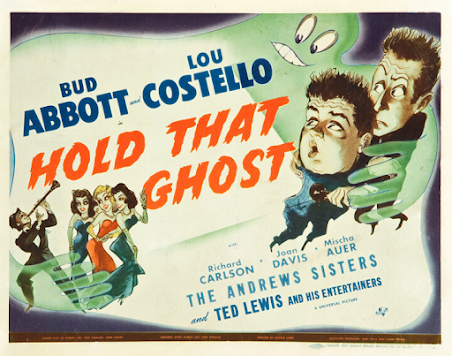
"Hold That Ghost" (1941)


Continuing to review the movies of Bud Abbott and Lou Costello, we hit "Hold That Ghost" from Universal in 1941!

As I mentioned last time, this movie (with the working title of "Oh, Charlie") was put on, well, hold in order to let "In the Navy" released as quickly as possible.


Despite their ample screen time in "In the Navy" and "Buck Privates," this is really the first film that lets the boys carry the main plot. It's kind of like instead of them being the comedy relief, there's now romance relief in support of the comedy!

(left to right) Joan Davis, Evelyn Ankers, Richard Carlson


The romance is supplied by Richard Carlson, who like Bob Cummings from "One Night in the Tropics," looks about the same here as he did in the mid-1950s and the lovely Evelyn Ankers, who was in a ton of movies for Universal, including "The Wolf Man," also from 1941!

Bud and Lou also get a solid comedy partner in Joan Davis, who has great chemistry with them, but apparently Lou thought she was a little too funny and was threatening to steal the picture!

But "Hold That Ghost" is a really fun movie and there are plenty of laughs to go around!

Joan Davis is definitely in this deleted scene from the original ending!

There's some controversy as to whether Joan Davis appears in the newly filmed ending. You see what would appear to be her character, but only from behind and she doesn't speak, so you'd think it was a stand-in, but some sources say it was her, but she was facing the wrong way. I know Universal was cheap and didn't like retakes, but wouldn't director Arthur Lubin had yelled, "Hey, Joan! Turn around!" or something?


Apparently Universal thought they should add some music to the movie while they were retooling it, so they filmed some bookends with the Andrews Sisters, since they had gone over well in the two service comedies.

Also featured in the musical portions is the very shticky Ted Lewis, a veteran bandleader who even by 1941 standards must have seemed dated. 

Ted does a couple of his old songs, including the so-non-PC-you-can't-believe-it-was-acceptable "Me and My Shadow" routine. Times were different, to be sure.

Anyway, the Andrews Sisters sing the main (only?) new song from the film, "Sleepy Serenade." which they naturally recorded for Decca:


Something of a contrast from the boisterous Don Raye songs from the earlier films!

And note how it says the song is from the New Universal Picture "Oh, Charlie" on the label!

Here's a version by Vaughn Monroe on Bluebird:


I've said before that it's interesting how Vaughn's early, pre-recording ban records are much more like "regular" band records than his later records which were more like vocal records, in keeping with changing musical trends.

"Sleepy Serenade" was also recorded as an instrumental by Claude Thornhill for the Okeh label:


A typically gorgeous arrangement from the Thornhill band. So underrated!


The Andrews Sisters also sing "Aurora" in the movie, although I think they had recorded the song earlier and it was shoehorned into the movie.

Here's their recording on Decca:


Interestingly, Decca had three other versions of the song (none of which mention the movie on the label), so let's hear them too!

Jimmy Dorsey recorded a lot of Latin-tinged songs, usually featuring Bob Eberly and Helen O'Connell, but only Helen appears on this:


Interesting. I have to say that I really don't care for Helen O'Connell's vocals on the whole. She was popular, though!

The Latin flavor continues with Pancho and his Orchestra:


A "Samba March," eh? Love it!

Then there's this off-beat polka version by "Happy" Harry Harden's Musette Orchestra:


That's awesome! I just love the muted trumpet!

Interesting that Pancho and Harry only use limited group vocals!

All in all, a really fun flick with reasonably entertaining tacked-on musical numbers!


Tuesday, March 8, 2022

Seasonal Songs - "The Things We Did Last Summer" - Part 1 - 1946


While it's still Winter, let's get to another seasonal song - "The Things We Did Last Summer" from 1946 by the prolific hit-writing team of lyrist Sammy Cahn and composer Jule Styne!

It's a popular standard, but despite it taking place, if you will, in the Winter, it hasn't made its way onto the list of seasonal songs that have been recorded ad infintum over the years, such as another Cahn/Styne song, "Let It Snow! Let It Snow! Let It Snow!"

When it was published, "The Things We Did Last Summer" was recorded on all the labels, with some pretty big star power!

My favorite version is by Jo Stafford on Capitol:


There's something in Jo's voice that conveys a wistfulness that really suits this song.

Another popular version was by Frank Sinatra on Columbia:


Frank sings the song well, but it's hard to imagine the skinny 1940s Sinatra being able to ring the bell at the midway!

Big-voiced Vaughn Monroe definitely sounds like he could ring the bell, though, and he cut the song for RCA Victor:


Of course, I "get" that the vocal group is called The Moon Maids because "Racing with the Moon" was Vaughn's theme song!

Decca got in on the action by teaming Bing Crosby with Jimmy Dorsey's band:


Bing and Jimmy went back a long way and always sounded good together.

The smaller Majestic label had Georgia Gibbs record the song:


Georgia's peak of popularity was about a decade later when she had several hits based on popular R 'n' B tunes, but this was back when she was known as "Her Nibs, Miss Georgia Gibbs," as she was called by Garry Moore on his radio program with Jimmy Durante.

So, some nice recordings!

(Obligatory mention that Jule Styne also composed the songs for "Mister Magoo's Christmas Carol," but you already knew that!)

Sunday, June 6, 2021

Christmas 1945: The Records Bonus!


As mentioned, there was one new seasonal song introduced in 1945 that had lasting impact: "Let It Snow! Let It Snow! Let It Snow!" by Sammy Cahn and Jule Styne!

Sammy Cahn in deep thought as Jule Styne looks on!

It was published and recorded in a number of versions in 1945, but was most popular at the beginning of 1946, as a winter song. In subsequent years, it's become co-opted as a Christmas/Holiday song, like so many others, and has been recorded so many times that it makes your head spin.

Let's get back to basics, though, and check out the "Billboard" chart from January 31, 1946, when the song hit Number One:


They mention the competing versions available, so we'll give them all a listen!


The biggest selling version was by Vaughn Monroe on Victor:


Curious that the blurb from "Billboard" has a typo and calls the Norton Sisters "Morton!"


Vaughn Monroe is an interesting case study, as he was a singing bandleader and as such was actually able to increase his popularity as the singers started taking over from the big bands. When he started recording in 1940, it was more like he was a bandleader who sang (and played trumpet), whereas by 1945 he was more like a singer who led a band - if that makes any sense!


Next up is Connee Boswell, whom we ran into in 1936 when she was a member of the Boswell Sisters (and still spelled her name as "Connie!"). By now, she was an established solo star and teamed up with Russ Morgan's band for this version on Decca Records:


Connee was a great singer and very much admired!


As seen in the lobby card above, Connee usually performed sitting down, the result of contracting polio as a child, but she overcame that disability to have a great career!


The most obscure artist of the bunch is Danny O'Neil, a talented singer when tons of other talented singers were fighting for the spotlight. He cut his take of the tune on the smaller Majestic label:


Not bad and definitely has more of an orchestral backing (courtesy of Ruby Newman) than the others, which have a "band" sound.


Speaking of band sounds, Woody Herman had assembled his "First Herd" by this time and they laid down this awesome version for Columbia Records:


Woody could really sing as well as play alto sax/clarinet and seemed more willing than a lot of veteran bandleaders to change with the times and I think Neil Hefti's arrangement on this record still has a fresh sound.


Sonny Berman has the trumpet solo here and Bill Harris plays the spectacular trombone solo!


Last up is another singing bandleader: Bob Crosby, forever known as Bing's younger brother, but a very successful performer in his own right. Here's his take on the independent ARA label:


Another solid version!

Bob sounded like Bing but I don't think tried to copy him. He had a great band before the war and formed a new group after having served in the Marines.

So, "Let It Snow! Let It Snow! Let It Snow!" was a popular sing back in the day that seemed to gradually morph into a holiday standard!


Popular (For Some Reason) Posts: