Yesterday we heard two songs popularized by Duke Ellington- “Cocktails for Two” and “My Old Flame” - wind up as classic Spike Jones parodies. For today’s side-session, we visit another tune recorded by both Duke and Spike: the 1928 standard Chloe (Song of the Swamp).
Duke’s 1940 Trek — The Swamp as Atmosphere
Duke recorded Chlo-e (with the old school hyphen) for Victor in 1940:
I’m absolutely fascinated by Tricky Sam Nanton on this one. His plunger-muted trombone always has personality, but here it crosses into something uncanny — a voice calling out across the marsh. It’s eerie, expressive, and completely alive. One of those moments where Ellington’s sound world feels like it’s breathing.
Spike’s 1944 Trek — The Swamp as Vaudeville
Spike Jones cut his version for Victor in 1944, shortly after the recording ban lifted:
This is controlled chaos at its best. Red Ingle is front and center with a bravura performance, and Country Washburne (Red’s old pal from the Ted Weems band) turns in another brilliantly unhinged arrangement. The City Slickers play it with that perfect balance of precision and anarchy.
And the label gag - Red billed as “Swamphead” - is exactly the kind of Victor in-joke that makes these records feel like a little clubhouse.
Tommy Dorsey’s 1945 Trek — The Swamp Swings
You’d think Spike’s record might have permanently tilted Chloe toward comedy, but Tommy Dorsey brought it back into the serious-swing column with his 1945 Victor version:
That’s Charlie Shavers on trumpet, absolutely tearing through Bill Finegan’s chart. It’s bold, brassy, and full of momentum - a reminder that “Chloe” still had plenty of musical life left in it.
Three Treks, One Swamp
So Victor Records take us on three very different journeys through the same murky landscape:
We hit 1934 with Duke Ellington and come across a pair of now-standard pop songs that Duke didn’t compose, but recorded popular versions of.
In addition to being written by the same team - lyricist Sam Coslow and composer Arthur Johnston- each song appeared in a different Paramount film featuring Duke and his orchestra.
And in a twist no one in 1934 could have predicted, both tunes would later become best-known through novelty records!
“Cocktails for Two” (from Murder at the Vanities)
Duke recorded this as an instrumental for Victor in April 1934:
It’s an interesting take. If I were given a blindfold test, I’m not sure I’d immediately say, “Hey, that’s Duke!” The arrangement is elegant but not especially Ellingtonian - which makes sense, given that this was very much a pop assignment.
Duke didn’t perform the song in the film itself; it was sung by Carl Brisson. The song itself celebrates the end of Prohibition!
“My Old Flame” (from Belle of the Nineties)
Duke did perform this one on screen, accompanying the film's star Mae West in the film. For Victor, he recorded his own version in May 1934 with Ivie Anderson on the vocal:
This one feels more like home turf. Ivie is wonderful, and the arrangement has more of that Ellington glow - especially with Cootie Williams delivering a classic growl-trumpet solo.
A fun label detail: the Victor disc says the song is from the Paramount film It Ain’t No Sin. That was the original title, but between Vanities and Belle of the Nineties, the Production Code went into effect, and a Mae West movie with the word sin in the title was not going to fly! Hence the last-minute retitling.
And if you ever see Murder at the Vanities, you’ll know instantly that it’s very much pre-Code!
Other Takes Before the Mayhem
After these initial recordings, the tunes had perfectly respectable lives in the swing era. Here are a couple of versions...
Tommy Dorsey and his Orchestra — “Cocktails for Two” (1938)
A swinging, polished version with TD on trombone, Johnny Mince on clarinet, Babe Rusin on tenor and Yank Lawson on trumpet. Very cool!
Cootie Williams and his Sextette — “My Old Flame” (1944)
Cootie revisits his old flame with a small-group lineup featuring Bud Powell on piano and “Lockjaw” Davis and “Cleanhead” Vinson on tenor and alto. Nicknames everywhere, and a wonderfully moody performance!
Now the Mayhem Begins
As mentioned earlier, both songs are perhaps best remembered today for their radical reworkings by Spike Jones and His City Slickers.
Spike Jones and his City Slickers - “Cocktails for Two” (1945)
This was cut at Spike’s first post–recording ban session and became the biggest hit of his career. His earlier Bluebird sides (like Der Fuhrer’s Face) were wacky, but this is where the controlled chaos really begins. During the ban, Spike and his brilliant arranger Country Washburne had developed this new, hyper-detailed approach - a kind of musical slapstick where every sound effect is perfectly placed.
And Spike could never really replace Carl Grayson after he left the band; his ability to sing a straight vocal and make those glugs was unmatched!
Spike Jones and his City Slickers — “My Old Flame” (1947)
If Cocktails is chaos, this is theater. The contrast between Paul Judson’s straight vocal and Paul Frees’ Peter Lorre parody is wild enough, but it’s what “Peter” says that puts it over the top. And the Slicker Chorus in the middle is brilliant!
Closing Thoughts
As a long-time Spike Jones fan, I first knew these songs through his versions. Sam Coslow was often quoted as disliking Spike’s treatment of “Cocktails for Two,” and it is hard to imagine a time when these songs were taken completely seriously.
But Duke’s 1934 recordings take us back to that moment - before the sound effects, before the anarchy, before the songs became punchlines.
They were just two new Hollywood tunes making the rounds. Duke gave them elegance; Spike later gave them immortality of a very different kind!
After enjoying The Flight of the Bumblebee on Wednesday, I
realized we can’t let the week go by without one more take on the tune - this time courtesy of Spike Jones!
The Chaos: The Jones Laughing Record (1946)
Spike used it as the basis for The Jones Laughing
Record, recorded for RCA Victor in 1946, and things get wacky fast.
Let’s give it a spin:
The laughter is absolutely contagious. And I love that the
label credits the side to Spike Jones and his City Snickers - one of his
best pun‑based band names.
The Technique: The Sneezin’ Bee (1957)
The yeoman work of ace studio trombonist Tommy Pederson
(brought in as a ringer) can get lost amid the chaos. Fortunately, Spike
revisited the concept in 1957 with “The Sneezin’ Bee,” included on his
Verve album Dinner Music for People Who Aren’t Really Hungry.
Let’s hear that one:
That’s essentially “The Jones Laughing Record” without
the laughing, giving us a chance to really appreciate Pederson’s dazzling
technique.
Here’s a fun clip from Spike’s TV show showing Tommy in
action — though this time pianist Frank Leightner is the designated
sneezer.
We can trace the whole “laughing record” concept back to 1922,
when Okeh released a German recording in the U.S. as The Okeh Laughing Record.It became a
sensation and spawned countless imitators.
Let’s hear it:
More than 100 years later, it still gets you laughing
along.
That record later inspired (and was included on the soundtrack of) the 1955 Walter Lantz cartoon
“Sh‑h‑h‑h‑h,” directed by the legendary Tex Avery.
Let’s watch:
That was the final theatrical cartoon of Tex - my
favorite cartoon director.
So tell me: how do you like your Bumblebee - with laughing
or just the sneezing? Are you team giggles or team hay fever?
I had just mentioned that I was familiar with Country Washburne from his work with Ted Weems, Spike Jones and Red Ingle.
The first time I remember seeing his name was on the label of one of Spike's "Other Orchestra" records.
So, here it is, the 1946 RCA Victor recording of "When Yuba Plays the Rhumba on the Tuba" by Spike Jones and his Other Orchestra featuring Joe "Country" Washburne:
That's some serious tuba chops!
This remake of the 1931 Herman Hupfield song was the flipside of Spike's most notable Other Orchestra record, the title song of the movie "Laura," so we need to hear that too:
One of Spike's best! I'm sure many listeners were caught off-guard when the City Slickers took over!
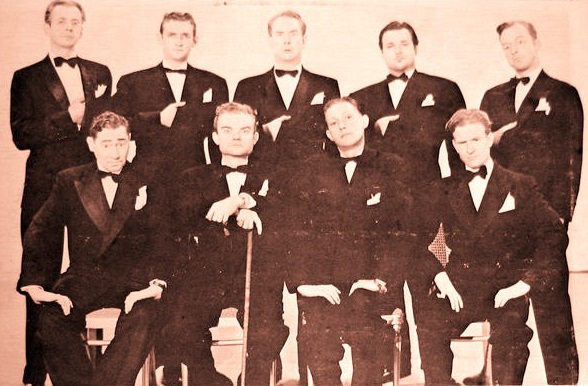
Spike and Del Porter are center front, Red Ingle is back center and Country is top right!
Still roaring along in 1928, our next college-themed song is "Doin' the Raccoon" by songwriters Raymond Klages and J. Fred Coots. Mr. Coots being best-known as co-author of "Santa Claus is Comin' to Town" a few years later!
The sheet music really evokes wacky college antics of the 1920s with raccoon coats and all!
The most popular version of "Doin' the Raccoon" was by George Olsen and his Music on Victor Records:
George Olsen's records have plenty of 1920s feel to them, but I think they were a bit square even at the time!
One of the most popular singers of the 1920s was Rudy Vallée, who was well-known for having attended Yale University. As such, he had a college-vibe, so it's not surprising for him to pop up with this budget label take on "Doin' the Raccoon":
The label says Rudy is accompanied by his Yale Men rather than the usual Connecticut Yankees. Hmmm...
I remember seeing Rudy Vallée on TV when I was a kid and it was hard to reconcile the older character actor with the "Vagabond Lover" of the 1920s, but he was a sensation back in the day!
For a sequel to "Doin' the Raccoon" we need to turn once again to Spike Jones, who included an original tune called "Doin' the New Raccoon" from his 1950 Charleston album:
Not sure what the story behind the song is, but Eddie Maxwell produced lot of original material for Spike.
The label credits the vocal duo as "Gil Bert and Sully Van," which is obviously a gag, but one of the singers is definitely former City Slicker Del Porter. It seems to be a bit of a mystery as to who the second singer was, but it may have been Eddie Maxwell himself.
We move into 1927 with our college songs and run into the hit show "Good News" with a score by the quintessential 1920s songwriting team of Henderson, DeSylva and Brown!
A big number from the show was "The Varsity Drag" so let's hear Cass Hagan and his Park Central Hotel Orchestra on Columbia Records:
Very snappy version of the song!
That's Franklyn Baur, Lewis James and Elliot Shaw on vocals!
The sheet music at the top makes mention of Abe Lyman and his Orchestra, as they performed as the pit band in the original production of "Good News" on Broadway.
We are very fortunate that the band filmed a version of "The Varsity Drag" about that time:
Lots of fun with Abe, who started as a drummer, displaying some showmanship!
For one more version of the song, let's jump to 1950 with this version by Spike Jones and his City Slickers on their RCA Victor album "Spike Jones Plays the Charleston for Dancing":
That is so much fun! Spike and wacky 1920s music are a perfect match!
Seems about time for a wacky version of "Jingle Bells!"
So, here's Ole Svenson and his Smorgasbord Band with "Yingle Yingle Yumping Beans" on S&G Records from 1950:
Pretty wacky!
Here's the flipside "I Vant a Xmas Drum":
The very end of the record is awesome!
I love Christmas music and I love novelty records, so I'm predisposed to enjoying this record, but there's another reason that it intrigues me...
"Ole Svenson" is really Bernie Jones, a singer/saxophone player who worked with Spike Jones and his City Slickers!
And "Yingle Yingle Yumping Beans" was co-written by former Slicker Del Porter! (Although how did it need four writers when it's already using the "Jingle Bells" melody?)
The Spike Jones connection gives this record some serious cred in the novelty world!
Bernie/Ole played with Spike from 1950-1955 after having worked with Ozzie Nelson's band. I understand he developed the character while with Ozzie.
The Ole Svenson character popped up on a couple of Spike's records, including his 1953 recording of "I'll Never Work There Anymore" on RCA Victor:
That's cute, but it doesn't have the oomph of Spike records from the 1940s. But I always enjoy hearing George Rock and it's great to hear Dick Morgan get a verse too.
Also in 1953, Spike had a concept album on RCA Victor, "Bottoms Up," which featured polkas ostensibly from different countries.
So, who better to sing the Swedish polka, "A Din Skál A Min Skál," than Ole? Here it is:
I feel like the "'Yumpin' Yimminy Fans" thing is a joke I'm not getting!
Del Porter would sometimes come back to the fold for guest vocals and he appears on a few "Bottom Up" tracks including the German polka, "Gesundheit Polka":
That's got a little more oomph and Del's vocals are always enjoyable!
The Ole Svenson character obviously sounds a lot like Yogi Yorgesson, the alter ego of Harry Stewart who broke through to mass popularity with his hit coupling of "Yingle Bells" and "I Yust Go Nuts at Christmas" in 1949.
The lines get blurred in 1955 when Yogi cut "The Ballad of Ole Svenson" on Capitol Records:
I wonder why Yogi used the Ole Svenson name. There's no particular reason to use that name on this Davy Crockett-inspired novelty. Just an inside joke?
You may recall that Yogi had some records for the same S&G label as Ole before Yogi signed with Capitol.
Bernie Jones kept using the Ole Sveson name on TV and records, including this 1957 album on the Verve label, "Hi-Fi Polka Party" by The Polka Dots Starring Ole Svenson, as produced by Spike Jones:
And since I seem to be doing a deep dive, I'll point out that the melody of "I Vant a Xmas Drum" is the Civil War pro-Union tune "Kingdom Coming."
Arrangers Eddie Sauter and Bill Finegan also used the song as the basis for their 1952 hit "Doodletown Fifers" on RCA Victor:
If you've seen the 1949 movie "It Happens Every Spring" or watched the trailer, you must have notice that it had a catchy title song, which was sung over the opening credits!
Well, said song was placed with all of the big record labels at the time, and they had some of their top artists record it. So, let's give 'em a listen!
Columbia Records had Frank Sinatra record it, backed by his usual collaborator Axel Stordahl:
Decca released this one by Dick Haymes with Gordon Jenkins:
And Capitol had Margaret Whiting with backing from Frank DeVol:
Those are three very talented singers and they all get outstanding arrangements. Stordahl, Jenkins and DeVol, all big band veterans, really knew what they were doing!
Next, we have former Benny Goodman vocalist Art Lund on the newish MGM Records label with Johnny Thompson (whom I don't know other than he backed Art Lund on several MGM records):
I like the vocal backing by The Crew Chiefs, who had formed with Glenn Miller's Army Air Force band, where they often backed Johnny Desmond!
RCA Victor issued the only big band version, by Freddy Martin and his Orchestra with a vocal from young Merv Griffin:
1949 was the same year that Merv recorded "I've Got a Lovely Bunch of Coconuts" with Freddy's band. I remember Merv joking about that being his only hit record!
In addition to those regular commercial releases, we also have a couple of 1949 versions from alternate sources!
The first is Kay Starr, who recorded it on a transcription disc:
Then we have what I've always thought of as the definitive version. It's by Spike Jones, who included it as the serious song on the June 25, 1949 broadcast of his show, sung by Dick Baldwin:
I knew the song from that LP release, which I listened to over and over before I had ever seen the movie!
In keeping with the situation, let's listen to some 78s!
The most famous Easter pop song must be Irving Berlin's "Easter Parade," which was introduced by Marilyn Miller and Clifton Webb in the 1933 Broadway show "As Thousands Cheer."
Clifton Webb recorded the song with Leo Reisman's orchestra for RCA Victor:
Sounds good!
It can be hard to reconcile the idea of Clifton Webb as a Broadway singer as he was so memorable as a star character actor in movies starting with "Laura" a decade later.
Among the many other recordings of "Easter Parade" was this 1942 hit instrumental version by Harry James on Columbia Records:
So many outstanding records from Harry and his band!
The second most popular Easter pop song is probably "Peter Cottontail," the 1950 novelty song written by Steve Nelson and Jack Rollins, who also scored with "Frosty the Snowman" later in the year.
The first artist to record "Peter Cottontail" was country singer Mervin Shiner on Decca Records:
That's a very appealing version and was quite popular.
A bunch of other versions were released in 1950 and it seemed to be especially popular with singing cowboys, as Gene Autry, Roy Rogers and Jimmy Wakely all got into the act!
But let's jump ahead to 1951 with this kiddie version by Spike Jones on RCA Victor:
A few things about this record remind me of Spike's record of "Rudolph the Red-Nosed Reindeer" from the year before.
First is that both records seemed aimed at the kiddie market. I know I've said before that Spike's 1950s records are often less edgy than his 1940s records and these are evidence of that!
Second is that Rudolph and Peter have the same cute voice. Marian Richman gets label credit as Peter, whereas Rudolph was ostensibly himself!
The third thing is that the label of each record credits one of Spike's writers for special lyrics, Eddie Maxwell for "Rudolph" and banjoist/vocalist/comedian Freddy Morgan on "Rudolph." You don't see such credits very often and it makes me wonder how that came about.
One more thing is that Spike's record of "Peter Cottontail" does not mention Easter at all, using "year-round" lyrics instead!
While we're on the subject of Spike Jones and bunnies and such, if we go back a few years to 1947 we have Spike's record of "Ya Wanna Buy a Bunny?" featuring George Rock:
From the moment the record starts, you can tell it's a zillion times wackier than "Peter Cottontail!"
"Ya Wanna Buy a Bunny?" was written by original City Slicker with his frequent co-writer Carl Hoefle and the pair also collaborated on "Yingle Yingle Yumping Beans!"
Back to Easter, we'll wind up with this snappy little coupling of "Easter Parade" and "Peter Cottontail" on Tennessee Records in 1952 from honky tonk pianist Del Wood:
Have a happy Easter and save me one of those Almond Joy eggs!
As the calendar turns to April, we celebrate April Fool's Day!
And who was more foolish than Doodles Weaver?
So, here's Doodles singing "April Showers" on a radio broadcast when he was the star comic with Spike Jones and his City Slickers:
A highlight of Spike's shows was when Doodles would attempt to get through a song in his "Professor Feitlebaum" character, inevitably being reminded of horses and launching into his famous horse race routine.
The horse race bit was immortalized on Spike's 1948 hit "William Tell Overture" on RCA Victor:
I wonder what Gioachino Rossini would think of the two most famous uses of his overture being the theme song of the Lone Ranger and the background to a Doodles Weaver comedy bit?
The flipside of Spike's record of "William Tell Overture" features Doodles mangling "The Man on the Flying Trapeze":
You'll notice that Spike refers to Doodles as "Winstead," which is Doodles's real first name. It's funny that he had such a proper-sounding name!
Doodles left the City Slickers in 1951, but still made the occasional record.
And never one to let a good bit go to waste, he recorded "April Showers" for the small Intro Records in 1952:
I think he was just great, the undisputed master of the spoonerism!
We've run into quite a few popular female vocalists of the late 1940s/early 1950s as we've gone along with "Jingle Bells," but there doesn't seem to have been too many of the corresponding male vocalists who recorded the song.
Frank Sinatra and Perry Como did record "Jingle Bells" in the 1940s, but newcomers like Frankie Laine and Vic Damone did not, although they did record some holiday material, whereas, say, Guy Mitchell and Johnnie Ray didn't seem to record any such songs at all.
But one big exception was Eddie Fisher, one of the most popular singes of the early to mid-1950s (and my mother's favorite), who recorded "Jingle Bells" in 1952 as part of his "Christmas With Eddie Fisher" 10-inch LP (also on on 45s and 78s) on RCA Victor Records:
The arrangement by Hugo Winterhalter is very busy and almost plays like a Winterhalter record with Eddie Fisher as gust vocalist, but it's good fun!
Now I know the reason I think this is because a couple of years later in 1954, Hugo Winterhalter had a hit record of "The Little Shoemaker" on which the label credit read "Hugo Winterhalter's Orchestra and Chorus and a Friend," the friend being one Eddie Fisher!
Here's that record:
Back to 1952 and Christmas, Eddie had another single from the album that paired two seldom heard songs:
Those two songs have the big production typical of his hits with Eddie's voice front and center.
Both songs also have a feeling of wistfulness wistfulness, which is even more pronounced on Eddie's recording of "Christmas Eve in My Hometown," which he recorded for the 1951 holiday season while serving in the U.S. Army during the Korean War:
That's a nice song and the introduction is interesting. It's kind of an "I'll Be Home for Christmas" for Korea.
Also interesting is that RCA pressed up another version of that recording for 1953 with the usual Hugo Winterhalter Orchestra and Chorus:
It's the label credit that catches my eye. I guess they had to say he was a "private citizen" since he wasn't in the army anymore!
I'm not sure if either of these recordings were available to the general public.
Of note is that the sing was later recorded by Kate Smith and Bobby Vinton. On the whole, those are not artists that would give a song street cred!
For my dough, the most memorable Eddie Fisher related Christmas record was this 1954 novelty song as recorded by Betty Johnson on the New Disc label:
That's just too funny! I love how the titles of some of Eddie's hits are worked into the song and the recitation!
Interestingly, the team of Joan Javitz and Phil Springer had written "Santa Baby" (along with Tony Springer) the year before. This one didn't hit it quite as big, though!
Being that Eddie was an RCA Victor recording artist, other labels probably wouldn't have wanted to release a version of the song, but RCA had Spike Jones cut it:
You'd expect something wacky, but the record is played very straight. The hint would be that the label credits Spike, but not the City Slickers. On the whole, it's pretty whelming. I appreciate the "Oh! My Papa"-style trumpet, though! Is it George Rock?
Within five years of the giddy heights of 1954, Eddie would divorce Debbie Reynolds to marry Elizabeth Taylor, tarnishing his image, have his RCA Victor recording contract and CBS TV show cancelled and my mother moved on to get married and start a family!
Still in a 1940s mood, let's celebrate New Year's Eve with a handful of 78s!
To ring in the 1940s, we start off at the end of 1939 with this typically idiosyncratic (in a good way) cut from the Raymond Scott Quintet on Columbia Records:
Always fun!
Of note is that the tricky trumpet part is played by Russ Case, later a prominent arranger/conductor for RCA Victor, working a lot with Perry Como.
Next up is Bing Crosby with another song from Irving Berlin's score for "Holiday Inn" on Decca:
Fun that Bing's brother Bob provides the backing with his band!
Leader Kay Kyser (right) introduces singer Harry Babbitt.
We jump ahead to 1947 for Kay Kyser's version of Frank Loesser's "What Are You Doing New Year's Eve" featuring Harry Babbitt on Columbia:
That's my favorite recording of that song. I'm always partial to big bands and Harry Babbitt might be my favorite band vocalist, having recorded a ton of great work with the Kyser band.
Another vocal group name to make me feel retro-smart is the Campus Kids. Kay Kyser's popular radio show was The Kollege of Musical Knowledge" so I get it!
I understand that Frank Loesser didn't think this song should be played at New Year's as the point is that the singer is jumping the gun with the title question. But, it does give a lot of people a chance to hear it every year, which can't be said of most 75-or-so-year-old songs!
Spike hopes his earmuffs block Doodles Weaver's "singing!"
We move to 1948 for the flipside of the massive Spike Jones hit "All I Want for Christmas (Is My Two Front Teeth) on RCA Victor:
I love that record! Having listened to so many Spike Jones recordings and radio shows, I feel like I actually know Sir Fredrick Gas, George Rock and Doodles Weaver, so I really enjoy hearing their resolutions!
Doodles really crams a lot in there!
And it's not a 1940s New Year without Guy Lombardo, is it? So here's the Royal Canadian's 1947 Decca record of "Auld Lange Syne":
We come to the end of our 1940s Christmas music playlist with a 1949 song that's one of the best-known Christmas songs ever: "Rudolph the Red-Nosed Reindeer!"
Gene Autry was the first to record the song on Columbia Records:
Rudolph's rise to fame in the music world parallels his story as the song was rejected all over town until Gene Autry recorded it as an afterthought and next thing you know, Rudolph and his song went down in history!
Rudolph started as an advertising character for Montgomery Ward (a once-mighty chain of department stores) created by Robert L. May in 1939. May's brother in-law, songwriter Johnny Marks, adapted he character into the song, which eventually was recorded by Mr. Autry.
The success of that song following Gene's earlier hit "Here Comes Santa Claus" from 1947 established him as the foremost purveyor of Christmas novelty songs. Despite his huge success as as singing cowboy in movies, Gene's most famous these days for those songs.
So many versions available for 1950!
"Rudolph" was so popular during the 1949 holiday season that it seemed like everyone who passed on the song before took a crack at it in 1950!
There's always a twist, though, isn't there? Peruse this ad from the "Billboard" issue of October 1 1949:
That indicates that Eddy Howard had already recorded his version for Mercury Records!
And, indeed, the issue from December 31, 1949 shows it as available on Mercury Record number 5360:
So, unless the Ghost of Christmas Yet to Come was working for "Billboard" magazine, Eddy's record was released in 1949, despite most sources saying it was 1950.
Let's give it a listen:
Fun effects on that one, but no points for copy editing on the label!
(Don't forget Eddy's recordings of the not-as-successful advertising character "Uncle Mistletoe" and not-as-loveable "Ebenezer Scrooge!")
That "Billboard" blurb also mentioned that "Rudolph" was also available by T. (Ted) Black on Dana Records, so let's listen to that one too:
That's also fun!
So, the moral of the story is that Gene Autry didn't have the only recording of "Rudolph" that was available in 1949, it's just that his was the first and by far the most popular!
We have one more rendition from 1949, this from the "Fibber McGee and Molly" show of December 6 featuring "Teeny" (Marian Jordan) singing with the King's Men:
Those lyrics are so different! Where did they come from? Did Ken Darby of the King's Men do a rewrite?
Incidentally, you may recognize announcer Harlow Wilcox from his similar duties on Basil Rathbone's recording of "A Christmas Carol" from 1942!
A couple of 1950's new recordings of note include Bing Crosby's version on Decca Records:
The way the song is presented plays more like a radio version to me, like an arrangement they would do on Bing's show, but not so much on a record. Unlike Gene Autry's version, it doesn't (teddy) bear up to repeated listening.
But fun to hear Rudolph make a little cameo appearance!
Whose nose is redder - Rudolph's or Spike's?
Another 1950 version of note to me is the one by Spike Jones and his City Slickers on RCA Victor:
Fascinating that Rudolph (himself) sings the whole song in the first person, expanding upon the Bing Crosby version, as if the events were happening in real time!
That's a really cute Rudolph voice. I think it's by Marian Richman, as she's credited with doing Peter Cottontail's voice on Spike's 1951 record of that song and it sounds similar. It's definitely not George Rock as I sometimes see!
Spike's version is also set up like a little audio skit and Spike's writer Eddie Maxwell even gets label credit!
Let's jump ahead to 1960 with one more version that also has a little framing story. It's by the Chipmunks from the Liberty Records LP "Around the World with the Chipmunks" also released as a single:
Rudolph's voice is closing in on the one from the famous Rankin/Bass TV special from 1964!
The original context of this cut was that David Seville and the Chipmunks met Rudolph while visiting the North Pole on their trip around the world. It was later included on the "Christmas with the Chipmunks" LP from 1962 and the countless reissues since.
There have been a zillion other recordings of "Rudolph the Red-Nosed Reindeer," but just like in the movies, Gene Autry always comes out on top!