Showing posts with label Perry Como. Show all posts

Monday, March 30, 2026

Monday Side-Session: The Many Moods of Indigo


Yesterday, we basked in the original instrumental glory of Duke Ellington's Mood Indigo. Today, we’re flipping the script to listen to how the vocalists took over!

The song acquired lyrics almost immediately. They were ostensibly written by Irving Mills, Duke’s manager, though I always wonder how much actual lyric‑writing he did. My hunch is that he sometimes subcontracted the words while still sharing composing credit with Duke (and in this case, Barney Bigard).

We have a bunch of vocal versions, so let's get started!

The Early Pioneers (1931–1933)

The first vocal version appeared in 1931, when Lee Morse and her Blue Grass Boys recorded it for Columbia:


That's great! And of course, “Blue Grass” didn’t mean “Bluegrass” in 1931 - no fiddles or banjos!


Next came Gene Austin (of “My Blue Heaven” fame), who recorded the song for Victor:

Is that perhaps the first time a Duke Ellington number was recorded as an out‑and‑out pop song?


Also in 1932, The Three Keys cut “Mood Indigo” for Columbia:

The label notes that “Bon Bon” is one of the group members - that’s the great George Tunnell, later featured with Jan Savitt’s band, and an early example of a Black singer starring with a white band.


It’s no surprise that the jazz‑leaning Boswell Sisters got their hands on an Ellington tune, and indeed they recorded “Mood Indigo” for Brunswick in 1933:


The Bozzies always sound great and how can you beat having the Dorsey Brothers for backup?


The Duke & The Divas (1940–1941)


As we move to 1940, we come to Duke Ellington himself, who recorded a vocal version with Ivie Anderson for Columbia:

I believe that’s Duke’s first session with the brilliant Jimmy Blanton on bass and Ben Webster on tenor sax. We’ll be hearing plenty from the Blanton/Webster band as we go forward.


Moving to 1941, we have a terrific version by Dinah Shore, from a Victor album tied to the radio show NBC’s Chamber Music Society of Lower Basin Street.


This was early in Dinah's long and successful career, but she already had the goods!


The Mid-Century Moderns (1950s)


Now we hit the 1950s with The Four Blazes on the small United label in 1952:


So nice and smooth!


Next comes another independent label entry: The Norman Petty Trio on Nor‑Va‑Jak in 1954.

RCA Victor’s subsidiary Vik picked up that recording for national distribution, and it became a hit. Norman Petty is, of course, better known as a producer - especially for Buddy Holly and the Crickets.


Also in 1954, The Modernaires teamed with fellow big band vet Georgie Auld for this version on Coral Records:


The Mods’ doo‑wops and Georgie’s tenor sax give it a distinctly mid‑’50s flavor!


Also in 1954, Billy Eckstine (himself a big band veteran) recorded the song for MGM:


It fits Mr. B like a glove!


Then perhaps the most famous big‑band alumnus of all, Frank Sinatra, included a terrific version on his 1955 Capitol album In the Wee Small Hours:


Frank and arranger/conductor Nelson Riddle are an unbeatable combination!


The Mills Brothers finally got around to "Mood Indigo" in 1958, recording it for their album Mmmm... on Dot Records:


That really does make you go Mmmm...


Next up in 1959 is the incomparable Nat "King" Cole. who included the song on his Welcome to the Club album for Capitol:


Just great! I understand that Dave Cavanaugh is conducting the Count Basie band there!


Also in 1959, Perry Como included the song in his RCA Victor album Como Swings:


I know I've said it before, but Perry was a sneaky-hip square!


Another long-time popular singing star, Doris Day, included the tune on her 1960 album What Every Girl Should Know for Columbia:


I think Doris is underrated as a vocalist these days, since she’s best remembered as a movie star - but at least she’s remembered.

We've really only scratched the surface of this song's life. Do you prefer the early, torchy 1930s takes, or the "Wee Small Hours" sophistication of the 1950s?

Friday, January 30, 2026

Friday Fun: More Columbo and a bit of "Stump"

As the week comes to a close, and since I like to keep a good thing going, I feel that we need to sneak in one more Russ Columbo song!

Let’s listen to perhaps Russ’s most popular number, Prisoner of Love from 1931 on Victor Records:

Like You Call it Madness, this song paints Russ as a tragic character - and a crazy level of romantic. Interestingly, Russ is credited as a co-writer on both songs. It’s hard to say what his exact contributions were, but I like to think he was the one who brought the angst!

The Mid-40s Revival

There was actually a mini-revival of Russ Columbo songs in the mid-1940s. As we saw yesterday, You Call It Madness had a few popular recordings, but the biggest hit of a Columbo tune came in 1946 when Perry Como waxed his version of Prisoner of Love for Victor.

Let's give it a spin:


This was a massive early hit for Perry, and it helped cement "Mr. C" as a major force for decades to come. 

Not to be outdone, Billy Eckstine wrapped his great pipes around the song for National Records in 1945.

Whom do you prefer: Mr. B or Mr. C?

I’m thinking the timeline suggests that someone realized these two Columbo songs were perfect for the "Modern Baritone" sound of Billy Eckstine. Mr. B’s 1945 recordings likely caught the ear of the biz, leading us right to Perry and Nat "King" Cole in '46. Whatever the case, we are all the beneficiaries!

The Wacky "Stump" Finale

Because I can’t resist such things, we need to listen to a wacky novelty version of Prisoner of Love that was “inspired” (or perhaps "inflicted") by Perry Como’s record!

Here is the incomparable Jo Stafford in her guise of “Cinderella G. Stump,” along with Red Ingle and his Natural Seven in 1947 on Capitol Records:

This was the follow-up to their massive hit Tim-Tayshun (itself a parody of a Perry Como remake of an early 1930s Bing Crosby tune). It’s as wild as you’d expect - and note that Jo actually gets credit on the label this time! "Cinderella's Back And Ingle's Got Her" - love, love, love it!

Red actually name-drops "Mr. Como" on the record, but it’s really more of a parody of the song’s high-drama lyrics than of Perry himself. Perry was likely a great sport about it - not only was he co-hosting the "Chesterfield Supper Club" radio show with Jo Stafford at the time, but he and Red Ingle were old buddies from their days together in the Ted Weems band!

From the tragic Russ Columbo to the hilarious Cinderella G. Stump... that’s just how we roll in the Warehouse.

Friday, April 29, 2022

Bonus 78s - Recording Ban Movie Songs - Part 2 - 1944!


So, when 1944 rolled around Decca and a lot of smaller record labels had settled with the American Federation of Musicians and were recording with musicians once again, so they had no further need for a cappella recordings.

But the giant RCA Victor and Columbia labels entered 1944 with no agreement, so they needed to issue vocal-only records in order to keep new product flowing.

So, let's listen to some 1944 movie songs from those labels! 

Side note: Capitol Records had also settled with the musicians' union in 1943, so they were back to business as usual, but I don't think they had issued any a cappella records. They had actually started up in April of 1942, which was just a couple of months before the recording ban started, so I guess they just rode out the storm.

RCA Victor had signed former Ted Weems vocalist Perry Como in 1943, so like Decca with Dick Haymes, they needed to get some product out there to keep their new singing star in the public eye. As a result, Perry recorded several records with a "mixed chorus."

Perry's first top-ten hit was his version of the beautiful Jerome Kern/Ira Gershwin standard "Long Ago (And Far Away)" from Columbia's "Cover Girl" starring Rita Hayworth and Gene Kelly:

I think that sounds great!

Dinah Shore had been successfully recording for Victor before the recording ban started, but she also cut some vocal only records with the "mixed chorus" (Decca credited the vocal groups, but Victor and Columbia did not).

Dinah appeared in a few movies in the mid-1940s, but like Perry Como, she preferred to concentrate on radio and later television, achieving huge success in those media in addition to a long string of hit records.

Dinah introduced the popular WWII song "I'll Walk Alone" in Universal's all-star "Something for the Boys" and had a huge hit record with it:

Very evocative of the era!

Dinah also appeared opposite Danny Kaye in the Goldwyn movie "Up in Arms," which was Danny's feature debut. Dinah had a hit with "Now I Know":


I had mentioned before that Dinah Shore had a somewhat different career arc from other singing stars in that she made a name for herself on the radio, especially Eddie Cantor's show, rather than having made her name singing with a band.

One of Dinah's rivals in the mid-1940s was Ginny Simms, who had come to prominence with the highly popular Kay Kyser band.


Ginny had appeared with Kay in his movies for RKO and made a few movies after beginning her solo career, including MGM's "Broadway Rhythm," in which she sang "Irresistible You." She recorded that song for Columbia with a choral background:


I do most associate movie Ginny Simms with her appearance in one of my favorite Abbott and Costello movies, "Hit the Ice" from 1943!

Let's jump back over to RCA for one more movie song released on their Bluebird subsidiary.

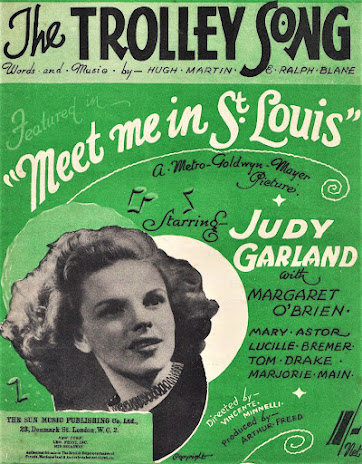
Here's the Four King Sisters singing "The Trolley Song," as introduced by Judy Garland in MGM's "Meet Me in St. Louis":

The King Sisters had been singing with the Alvino Rey band (Alvino and Luise King were married) and made some popular records but later found their greatest fame with the King Family on 1960s TV.

Next we go back to Columbia Records for the gentleman who kind of jump-started the whole former-band-singer-turning-solo-star thing - Frank Sinatra!

Frank had sang (sung?) with Harry James's band, then achieved great popularity with Tommy Dorsey before making the bobby-soxers swoon in his solo theater appearances.

He started making movies and signed with Columbia Records, who had to get some records out to take advantage of the publicity!

Frank's movie debut as a solo star was "Higher and Higher," which had some great songs by Harold Adamson and Jimmy McHugh including "I Couldn't Sleep a Wink Last Night" and "A Lovely Way to Spend an Evening," which were paired on this record:


The uncredited chorus is the Bobby Tucker singers with Axel Stordahl supervising.

Another song from "Higher and Higher" had a title that ironically summed up the whole situation:

The music stopped, but they kept on singing!

I really enjoy these records and I'm glad these great movie songs were preserved as such - band or no band!

Wednesday, April 27, 2022

Seasonal Songs - "I Love You" (1944)


Now that we're firmly into the Spring season, let's listen to a seasonal song!

There aren't nearly as many Spring songs as Winter songs, but there is quite a nice sneaky Spring song in the form of Cole Porter's "I Love You" from the 1944 Broadway musical "Mexican Hayride."

There were a number of recordings of the song in 1944, led by Bing Crosby's big hit version on Decca Records:


Bing was at the top in 1944, with hit records, the popular "Kraft Music Hall" radio show and the multi-Oscar winning movie "Going My Way." I don't think such pop culture domination has ever been equaled!

Bing was able to record "I Love You" with instrumental backing from John Scott Trotter because Decca had settled with the musicians' union and was recording as per usual.

Capitol Records had also settled and they had Paul Weston back their new singing star, Jo Stafford:


As noted before, Jo had led the Pied Pipers vocal group with Tommy Dorsey's band, then moved with them over to Capitol before starting her successful solo career.

Another popular version of "I Love You" was recorded by Enric Madriguera and his Orchestra with vocalist Bob Lido on the Hit label:


A lot of smaller labels had also settled with the union and filled the void with recordings of hit songs in 1943 and 1944. 

I'm not sure what the deal is with this next 1944 record, but it seems like it was recorded for use on WOR, the big New York radio station which recently celebrated its 100th year on the air.


Whatever the case, it's by veteran bandleader Jan Garber, "The Idol of the Air Lanes," who during the early to mid-1940s had adopted a more swingy musical approach as opposed to his earlier and later Lombardo-inspired style.

Here's Jan's band with Bob Davis on the vocal:


I appreciate that as the only real big band version of the song!


Another small label, Sonora, had noted Broadway arranger Russell Bennett record "I Love You" for his "Broadway Hits of Today" album:


I like that a lot! Extremely charming vintage sort-of-serious sound!

So, Decca and Capitol and several smaller labels were recording again, but huge players RCA Victor and Columbia did not settle with the musicians' union until very late in 1944, so "I Love You" couldn't get recorded by popular bands like Tommy Dorsey, Harry James, Benny Goodman or a ton of others who were signed to those two labels.

RCA Victor and Columbia (and Decca before their settlement) did, however, continue to record some new sides featuring singers only. 

Columbia issued several numbers by new singing sensation Frank Sinatra with the Bobby Tucker singers as the only accompaniment, but the label did not have Frank (or anyone else) record "I Love You" at the time.

RCA had recently signed their own new vocal star, Perry Como (formerly of the Ted Weems band), and his first records for the label were a cappella recordings featuring a mixed chorus as backing.

Here's Perry's version of "I Love You":


I like that a lot and don't really miss the instrumentalists!

So, the hit song "I Love You" from the hit musical "Mexican Hayride" was very popular in 1944, but whatever happened to that show anyway?


Well, the movie rights were purchased by Universal-International and for some reason, the studio repurposed the material into a 1948 vehicle for Bud Abbott and Lou Costello!

Along the way, all of the songs from the musical were dropped! Why would a penny-pinching studio like Universal lay out the money for a Cole Porter musical and not use the songs?

I'm a big Abbott and Costello fan, and although the oddly disjointed plot of "Mexican Hayride" doesn't make much sense, to me the boys are in good form and have some great routines in the film, probably none of which were from the show!

I'm guessing that because the movie version of "Mexican Hayride" is basically just another A & C movie is the reason why the show seems to have drifted into obscurity.

In any event, "I Love You" is a great song with which to celebrate Spring!

Sunday, February 13, 2022

"Winter Wonderland" - Part 4 - Child's Play!


So, we saw how "Winter Wonderland" enjoyed a resurgence in popularity with some successful recordings from 1946.

I presume that's what led to a new "children's lyric" being added in 1947, making the song more kid-friendly.

The most noticeable change is that the singer suggests pretending the snowman is a "circus clown" rather than Parson Brown, as kids are more likely to be thinking of frolicking and playing rather than getting married!


A more subtle change is that the new bird is singing a song, rather than a love song, a distinction lost on most versions that include the children's lyric.


That's for children, all right!


Although the children's lyric seems to have been published in 1947, I can't find a recording that includes them until Rosemary Cooney in 1953 on Columbia Records:


That's quite a nice version and Rosemary includes both the original and children's lyrics, sung with the proper wording for maybe the only time?

That seemed to be a new template for versions of the song, to sing the original lyric first, then the children's lyric the second time through the song.

Johnny Mathis recorded perhaps the definitive vocal version for his 1959 "Merry Christmas" album, also on Columbia. singing both lyrics with the verse in between:


Very fun with a great arrangement from Percy Faith, but Johnny sings "he's singing a love song" instead of "he's singing a song" on the second chorus. Was that a flub?

Another intriguing version from 1959 was recorded by Ray Martin for the RCA Victor various artist album "The Merriest of Pops":


The arrangement is kind of half-vocal/half-instrumental with the chorus only singing some of the lyrics, but using the children's lyrics!

I like it!

Perry Como revisited the song in 1959 for his "Season's Greeting" LP on RCA Victor, sticking with the original lyric:


This new version is taken at a much more leisurely pace than 1946's!

Also revisiting the tune around this time was Guy Lombardo, who included it on a couple of albums for Capitol Records, which he joined in the mid-fifties after 20-ish years with Decca.

Let's listen to the 1960 stereo version from the "Sing The Songs Of Christmas" LP featuring long-time Lombardo vocalist Kenny Gardner:


The idea of that album is that you sing along with the kids who are singing along with Kenny. Not sure if it was really recorded live, but the kids are definitely not on the beat! 

Maybe they should have used the children's lyric!

We continue a bit further into the 1960s with the version that I most identify with the "circus clown"  children's lyric - Robert Goulet's from his 1963 album "This Christmas I Spend with You" on Columbia Records:


My mother was a huge fan of Robert Goulet and I heard that album a lot as a kid! Good thing I like it!

We'll make one more stop before we go for now, with one of the odder variations of "Winter Wonderland," this one from Peggy Lee's 1965 Capitol album "Happy Holiday":


Peggy uses only the children's lyric, but she sings "Santa clown" rather than "circus clown," which kind of makes you go Huh?

Lots of versions have followed with lots of variations. I think Parson Brown is still in the lead, though!

Friday, February 11, 2022

"Winter Wonderland" - Part 3 - The Revival!


So, we heard a bunch of versions of "Winter Wonderland" from the song's initial period of popularity that followed its publication in 1934.

It seems that the song was then largely forgotten, as is the case with most popular songs of the day, as new songs came along. It certainly was a long way from becoming the perennial seasonal standard that it's become.

In fact, I don't the song was recorded for another ten years or so after 1935, but it came back in a big way after WWII was over.

For some reason (maybe post-war audiences were nostalgic?), 1946 saw three new popular versions of "Winter Wonderland" on major labels!

Leading the way was Johnny Mercer on Capitol Records. We heard it back here, but let's listen again:


Nice, mellow vibe from Johnny with the Pied Pipers and Paul Weston's orchestra.


Perry Como had the swingiest take on the song on RCA Victor, which we first heard back here, but it's definitely worth another listen:


That's probably my favorite vintage version. I like how the Satisfiers are billed right up there with Perry!


Decca Records also got in on the act with the original "Winter Wonderland" hit-maker, Guy Lombardo, teamed with the Andrews Sisters:

This was the flipside of "Christmas Island," making for a popular record.

I think the Lombardo band sounds less Lombardo-ish here, giving a nice background for the Sisters.

They include the rarely heard verse in the middle, which is fun!

With these three records all selling well and the business of seasonal records getting bigger and bigger, "Winter Wonderland" was on its way to becoming a seasonal perennial!


RCA Victor was back in 1947 with Sammy Kaye's recording as part of the ten-inch album "Year 'Round Favorites":


That's old school "Swing and Sway" with the singing song title at the beginning and vocalist introduction by Sammy in the middle!

Also in 1947, as we heard here, the small Signature label released a great version by Johnny Long and his Orchestra with vocalist Francey Lane:

Love it!

It took a couple of years for the other major record label, Columbia, to get with the program, but in 1949 they released this fine version by Buddy Clark:


Good backing from the Girl Friends and Ted Dale's orchestra.

This was paired with "Merry Christmas Waltz" and was also recorded at Buddy's last studio date.

Lots of good music in the post-war Winters!

Wednesday, November 17, 2021

"Jingle Bells" - Part 76 - Mr. C!


We just heard Perry Como with "The Christmas Symphony," which leads to the obvious question of whether Perry ever recorded "Jingle Bells." The answer is of course he did!


Here's his 1946 recording issued on RCA Victor as part of the "Perry Como Sings Merry Christmas Music" album of 78s:

Nice version with solid backing from Russ Case!

That particular album yielded a separate single release with the new song "That Christmas Feeling" on the A-side:

The flipside is a swinging take on a by-then familiar standard:

Both of those sides have been mainstays on my 1940s Christmas playlist for years!


Another one of those retro-type things I feel smart about "getting" is that the backup vocal group was named the Satisfiers because they appeared with Perry on "The Chesterfield Supper Club" and, as we know, Chesterfields satisfy!

Perry Como recorded a lot of other Christmas songs and he also re-recorded some when stereo rolled around, but I think he only recorded "Jingle Bells" the one time.

But, RCA Victor got a lot of mileage out of it!

Perry released a Christmas EP in 1953 titled "Around the Christmas Tree":

The EP's leadoff track was a recitation of "'Twas the Night Before Christmas":


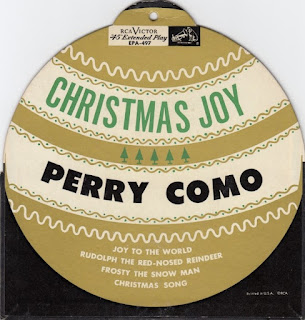
There was also another EP in 1953 with the title "Christmas Joy":

This included a version of "Frosty the Snowman":


The EPs featured backing from Mitchell Ayres, another frequent Como collaborator.

Seven of the songs from the original 78 rpm album were joined with the eight from the two EPs for the 1956 LP release retaining the 78 album title of "Perry Como Sings Merry Christmas Music":


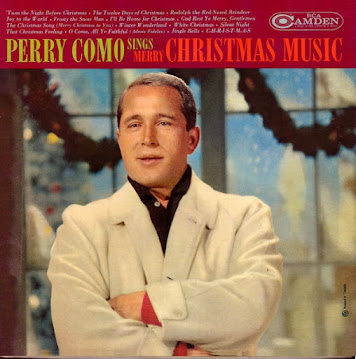
Then RCA re-released that album with a new cover on their budget Camden label in 1961:


My family had that one (I still have it) and we played it a lot during the holiday season!

Another RCA imprint was the Bluebird label, which had been a lower-priced, but high-quality label in the 1930s and 1940s, but was later used for kiddie records in the 1950s.

RCA went old school and paired Perry's recording of "Jingle Bells" with his 1946 recording of "Santa Claus is Comin' to Town" (which didn't make it onto the LP) for a 1957 release:

Here's "Santa Claus is Comin' to Town":


More solid backing from Russ Case and the Satisfiers!

I think those two songs were first teamed up on as the B-side of a 1953 EP that had "The First Christmas" as the A-side:

That recording had been issued in  as a two-sided 78 rpm record in 1950:

Here it is:


The year 1957 also saw this Australian release with a fun ornament packaging reminiscent of the earlier EPs:

It had "The Night Before Christmas" on one side, with "Jingle Bells" and "Frosty the Snowman" on the other.

Then from 1958 is this Italian release that put 1946's "White Christmas" with "Jingle Bells" inside the wacky sleeve:


Here's "White Christmas":

That features backing by Lloyd Shaffer and was the only track from the original 78 album not to feature Russ Case.

All of this just scratches the surface of Perry Como's holiday recordings, as he had many other singles and albums.

He looms very large in the Christmas music world!


Popular (For Some Reason) Posts: